
FORTE CULTURA Station: Medzhybizh Fortress (UA)
White Swan of Podolia
The eventful history of a city and its fortress
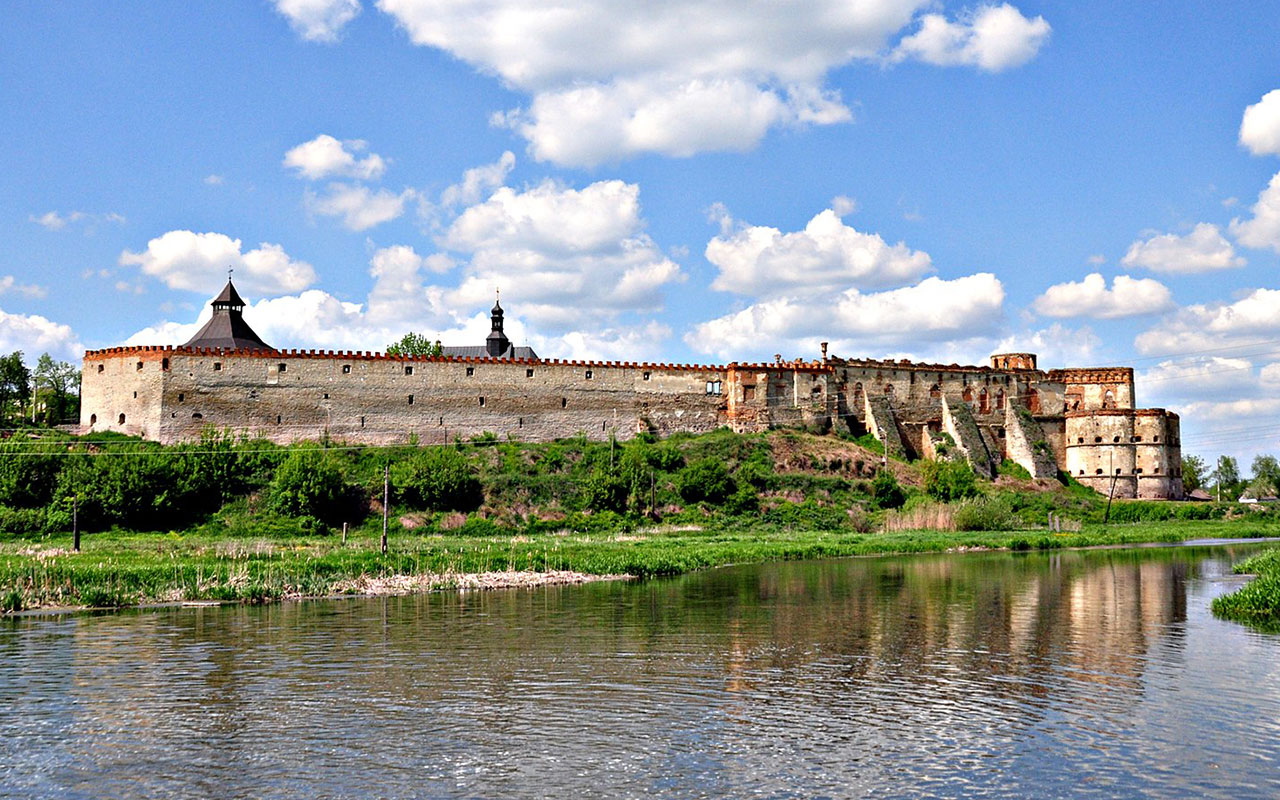
In the west of Ukraine, on the banks of the Southern Bug, stands the Medzhybizh Fortress. The impressive bulwark features a variety of different architectural styles and periods of defence architecture. The fortress combines features of a medieval castle with the mighty modern fortress styles of the Renaissance.
Today, the Medzhybizh fortress is part of a state historical and cultural reserve in Ukraine. Within the imposing walls are museums on the history of the region, ethnography and the Holodomor (famine in the Ukrainian Soviet Socialist Republic in 1930). Key battles and conquests as well as the chequered history of Medzhybizh rule are presented in detail. Festivals and cultural events bring history to life for visitors.
At the time of the Russian war of aggression against Ukraine in 2022, Medzhybizh Fortress once again became a shelter and refuge for many refugees, especially women and children. In April 2022, FORTE CULTURA awards Medzhybizh Fortress the status of an official "Station of the European Cultural Route". FORTE CULTURA is thus sending a signal of solidarity for the people of Ukraine.

Discover Medzhybizh Fortress in Ukraine:

Medzhybizh was a fixed lock, which leads to a Fortress was expanded.
Medzhybizh Fortress
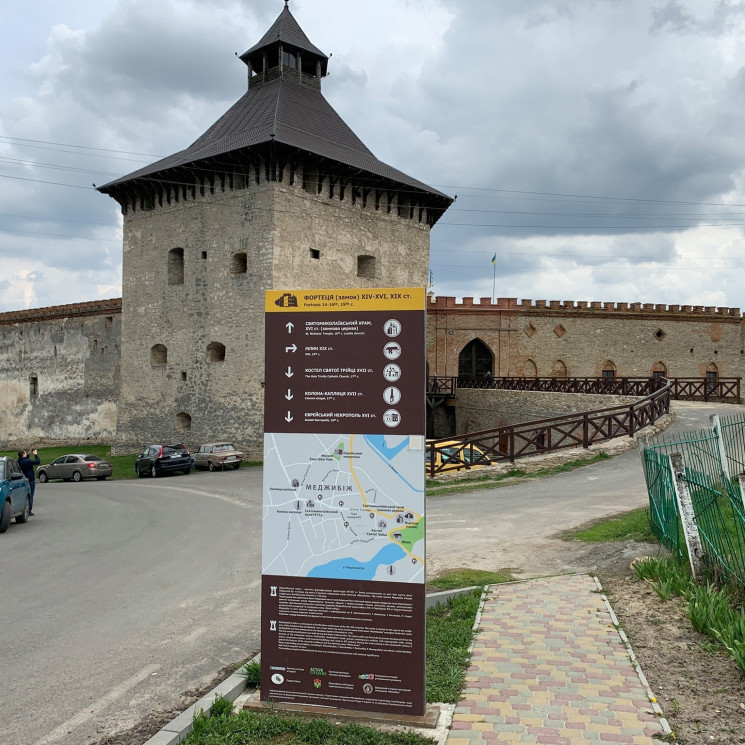
Medzhybizh Fortress is situated in the historic region of Podolia, between the Southern Bug and the Buzhok, and was also known as the White Swan. It was built in the 1540s by Captain Nikolai Siniawski as a bulwark against Ottoman expansion and went on to become one of the strongest fortresses of the Crown of the Kingdom of Poland in Podolia.
Castle Building – Museum of Ukrainian Regional History
Senjawski-Chortorysky Palace
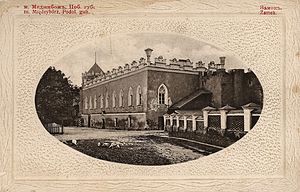
The castle building within the Medzhybizh Fortress is so unique in its diversity that it is unlike any other Ukrainian castle. The building illustrates the transition from a castle to a palace. Many Renaissance features can be found within the fortress.
The collection of archaeological artefacts found on the grounds of the fortress and at the Rakovets estate near Medzhiborz is the highlight of the exhibition in the historic halls. There are also artefacts from the Trypillia culture, the Chernyakhivka culture and the Kievan Rus„ culture. The halls are dedicated to the National Uprising led by B. Khmelnytsky, the 12th Hussar Regiment of the Okhturks and the Jewish community. In the “National Weaving’ hall, you can see the handicrafts of the villagers and woven garments known since ancient times. On display here are carpets, towels, tablecloths and linen shirts, as well as looms, warps, heddles, spindles, yarn and so on.
The final room displays his own works of art – icons from the 19th and early 20th centuries: „King of Glory“, „Calvary“, „Resurrection“, „Panteleimon the Confessor“ and others from the famous Kyiv School of Icon Painting by Novitsky.
Holodomor Museum at Medzhybizh Fortress (1930-1932)
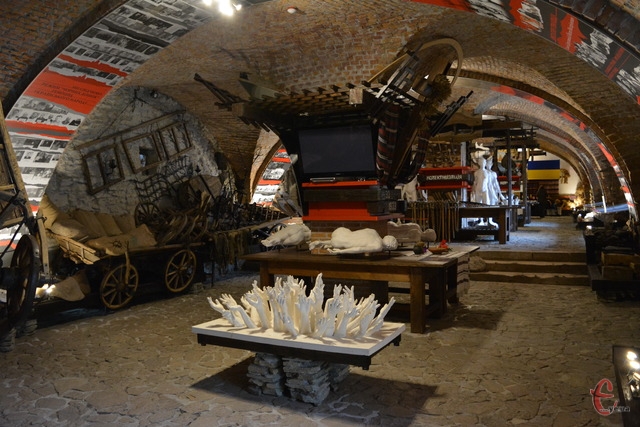
The museum opened on 4 October 2008 and is dedicated to the tragedy of the Holodomor of 1932–1933. It is the first museum in Ukraine to focus exclusively on the tragedy of the Stalinist genocide against the Ukrainian people.
The museum is designed in such a way that visitors can almost feel the drama of the labour, lives and deaths of ordinary people, and numerous allegories and symbolic compositions speak without words, conveying the story of the Holodomor to the hearts of our contemporaries.
In fact, this entire epic exhibition – comprising hundreds of tools used by farmers, craftsmen and in the home, sculptures and paintings, is a single museum piece, a large-scale artistic installation into which the visitor is drawn, experiencing the horror of hunger, the burden of injustice and, at the same time, the hope for life.
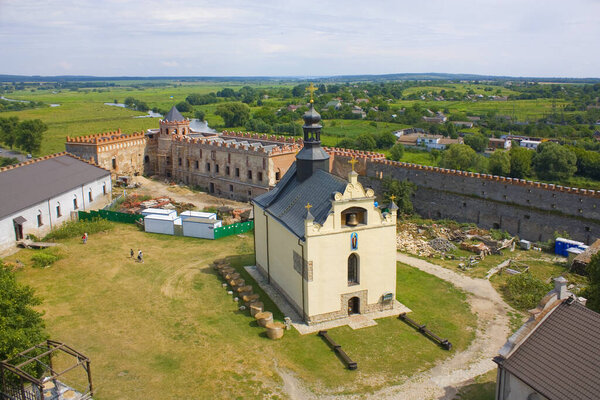
St Nicholas’ Castle Church
The renovated Orthodox Church of St Nicholas, located within the Medzhybizh Fortress, was originally built in 1564 (or 1586?) as a Polish Catholic church.
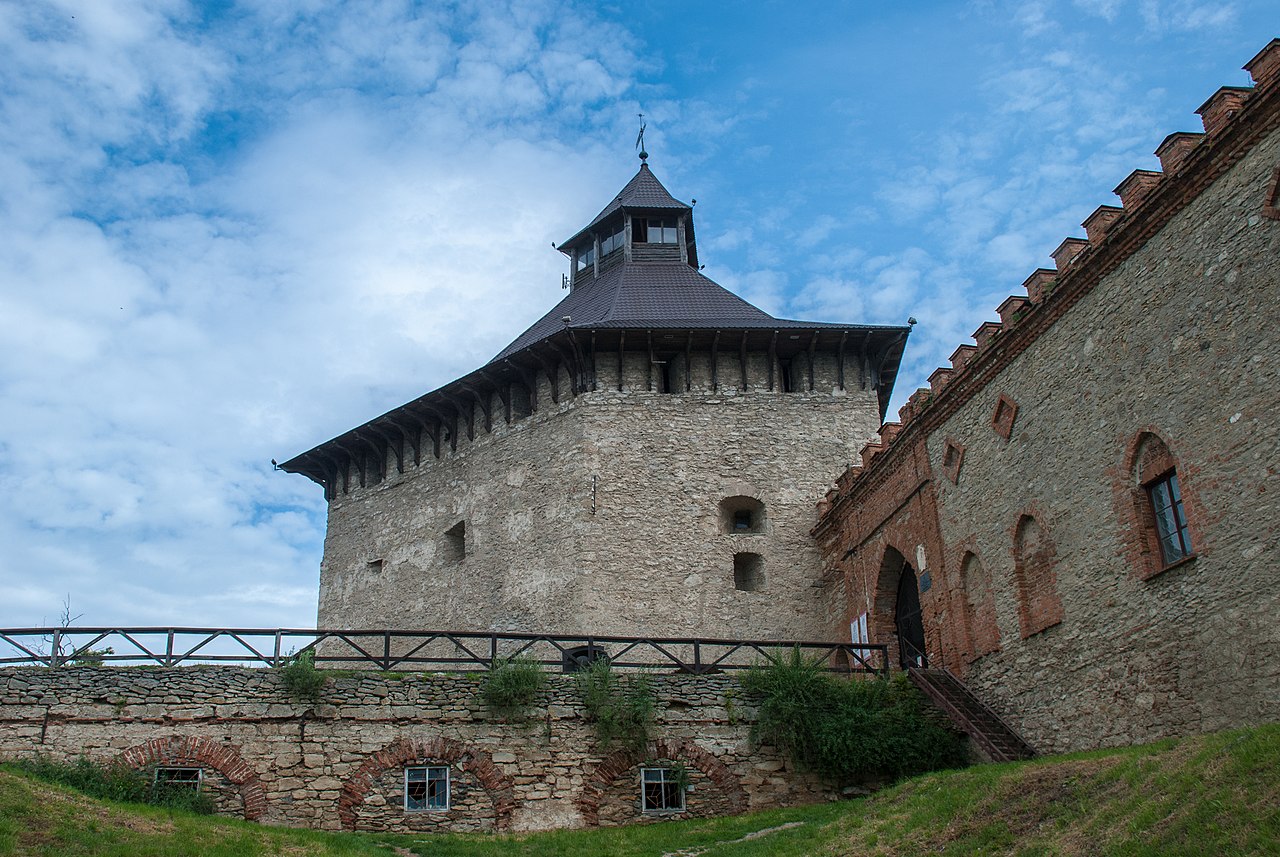
Tower
The tower building at Medzhybizh Fortress has a viewing platform, and outside there is a monument in honour of Taras Shevchenko, the Ukrainian national poet and painter.
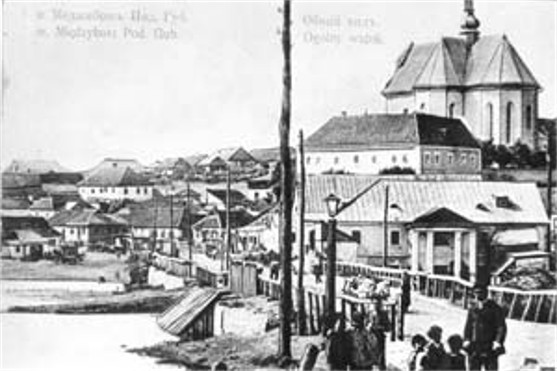
The Shtetl of Mezhybizh
The shtetl of Medzhybizh
Mezhybizh was initially a town under the suzerainty of the Prince of Kyiv, before coming under Lithuanian rule and, in the 16th century, passing into the control of the Polish noble families Sieniawski and Potocki. The town was attacked several times by the Tatars, which forced the Poles to fortify it and build dykes along the River Boug to create protective lakes.
The first references to Jews in Medzhybizh date from the early 16th century. These documents show that certain Jews were granted special privileges by the Polish kings, and they refer in particular to King Sigismund II’s proclamation of 1566, stating that the Jews of Medzhybizh were permanently exempt from taxes. The oldest burial in the Jewish cemetery dates from 1555. The 1571 census records the presence of 95 Russians, 35 Jews and 30 Poles.
The Cossack Uprising
Having built what was thought to be an impregnable fortress, Bohdan Khmelnytsky’s Cossacks managed to invade the region in 1648. At that time, the total population of Medzhybizh stood at 12,000, more than half of whom were Jewish. According to a Jewish historical ballad, 5,000 Jews were massacred by the Cossacks in Medzhybizh that year.
In 1649, John II Casimir and Khmelnytsky negotiated a treaty to end hostilities, but the pogroms continued between 1651 and 1653. By 1661, only a handful of Jews remained in Medzhybizh. The last Cossack uprising took place in 1664. In 1678, the census recorded only 275 Jews in the region.
Throughout Ukraine, but particularly in this region, memories of uprisings and pogroms run deep. Jewish blood was shed here by Cossacks, Swedes, Poles, Ukrainians and Germans. Anti-Jewish violence reached its peak during the infamous Khmelnytsky massacres of 1648–49 and is documented in Rabbi Nathan Hannover’s monumental work *The Abyss of Despair*, a renowned chronicle of Jewish life in Russia and Poland in the 17th century. Bohdan Khmelnytsky was the leader of the Cossack and peasant uprising against Polish rule in Ukraine in 1648, which led to the destruction of hundreds of Jewish communities. For Ukrainians, he is a national hero; for Jews, the name Khmelnytsky is synonymous with terror, murder and oppression.
The Jewish rabbi Baal Shem Tov, the founder of Hasidic Judaism, lived here in the 18th century, and so the fortress is regarded as the birthplace of the Jewish religious movement known as Hasidism.
Jewish ghetto and mass grave
During the Second World War, the shtetl served as a Jewish ghetto to support the Organisation Todt in the construction of German motorways in Ukraine. A memorial commemorates the approximately 3,000 Jews from Medzhybizh who were executed in 1942 in three nearby ravines to the west of the town.
Despite the war, the museums at Medzhybizh Fortress are open and guided tours are available. If you would like to support the fortress financially, you can contribute to our fundraising campaign. Every donation helps.
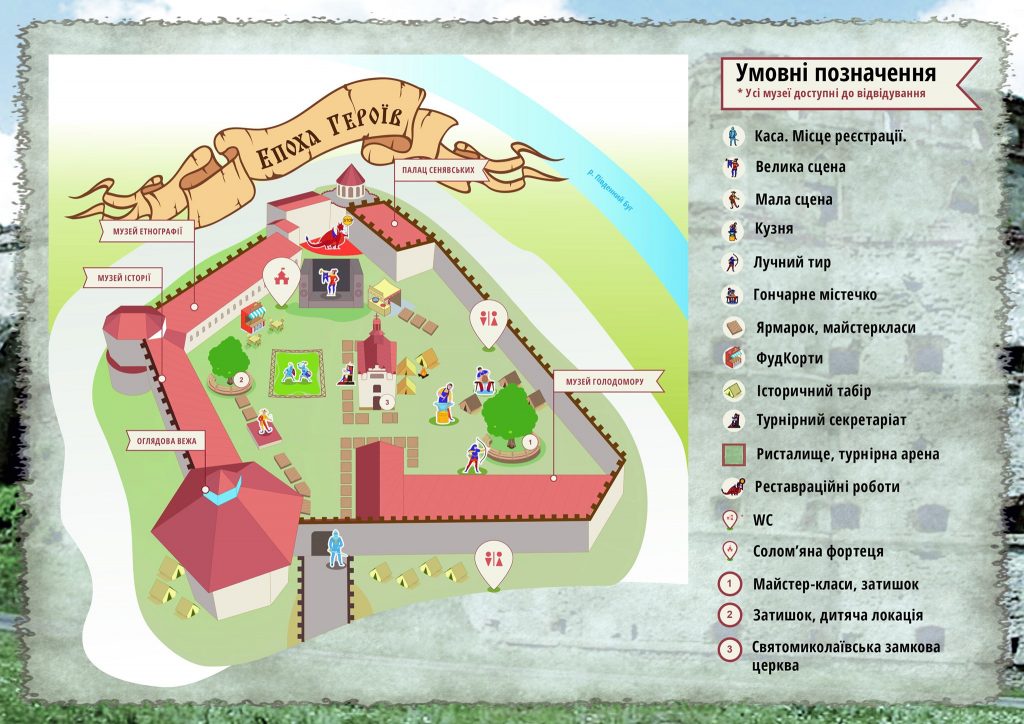
History
On the banks of the Southern Bug
The archaeological sites in Podolia around Medzhybizh prove, through the discovery of stone and flint tools, that the Acheulean culture was already settled there as early as 900,000 BC. This makes the Palaeolithic settlement at Medzhybizh one of the oldest records of human life in the territory of Ukraine. The first wooden fortification in Medzhybizh is documented in the Hypatian Chronicle of 1146 as a gift to Prince Svantoslav. In 1593, the town was granted Magdeburg rights and developed into a thriving cultural centre during the 17th and 18th centuries. During the Polish–Cossack War of 1648–1657, three major battles took place around Medzhybizh. In 1666, the town was captured by Ottoman troops and held for 27 years.
A BRIEF HISTORY OF THE TOWN.
MEDZHYBIZH – formerly a town, now a municipality, situated at the point where two rivers – the Bug and the Buschok (hence the name – Mezhybish, Mezhybizh) – converge. The first known chronicle mentioning the place dates from the year 1146. „… Yislaw, who had led Vsevolodovich Svyatoslav to Christ, gave him Bozhykiy and Medzhybish (a total of five towns…)“, we read in the „Chronicle of Rus“.
Medzhybizh was part of the Principality of Galicia-Volhynia; in the 14th century, it became one of the towns of the Province of Bologna. During the Lithuanian period, when Olgerd drove the Tatars out of the region in 1392, it belonged to the Koryatowicz princes and later became part of Poland. From 1540, it was owned by the Seniavsky magnates and remained in the family’s possession for 200 years. In 1593, the Senyasci family was granted Magdeburg law for Medzhiborz. A town council was established here, craft workshops sprang up, two public auctions were held daily, and several fairs took place each year. The town grew quite populous: at the beginning of the 18th century, it had 12,000 inhabitants.
Significant events took place here during the turbulent period of the Ukrainian people’s War of Independence and National Liberation, led by B. Khmelnytsky between 1648 and 1657. Kryvonos defeated the Polish nobility and captured the town; in June 1649, a famous battle took place at the castle walls between the Polish army and the Cossack regiments of Danylo Nechai; and on several occasions, B. Khmelnytsky was escorted to the castle on several occasions.
At the end of the 16th century and the beginning of the 18th century, the village of Medzhybizh was closely linked to Lviv and the Lviv community. As they were engaged in trade and manufacturing in Lviv, they brought books to Medzhybizh and supplied goods to Lviv. Medzhybizh also had links with Kyiv. Medzhybizh is mentioned in the 18th-century ‘Chronicle of Lviv’, which covers events from 1493 to 1649.
There were several churches and associations in Medzhybizh, one of which – the Church of the Assumption of the Blessed Virgin Mary – was built in the 18th century. The Church of the Assumption was an outstanding example of fortified church architecture. The Jewish community in Medzhybizh was quite large. In the mid-18th century, a distinctive religious movement, Hasidism, developed here. It was founded by I. Baal Shem-Tov (Besht), who lived in Medzhybizh for 20 years and was buried there in 1760.
The Czartoryski family, who owned Medzhybizh for 100 years (1730–1831), made the town their seat of power. In 1792, Medzhybizh served as the headquarters of Tadeusz Kościuszko.
In 1831, the Czartoryski estates were confiscated; military settlements were established in the surrounding area, and Medzhybizh became a military post centre, where the so-called „camp“ was set up. It was here that the „Tabor“ gatherings were held. The castle served as the headquarters of the 12th Achthyrski Hussar Regiment, commanded in 1901 by Grand Duchess Olga Olexandrivna Romanova, the full sister of Tsar Nicholas II. Following the revolutionary upheaval of 1917, the Bolsheviks seized power in the country. In 1923, Medzhybizh became a district centre and remained so until 1959.
Unfortunately, very few historic monuments have survived, and those that remain are in a state of disrepair. The Troitsky Church, dating from 1632 (registration number 1694), is now in ruins; the historic appearance of the adjacent house (the mansard) has also been lost, and a shopping centre has been built. The town hall and the Dormition Church, with its beautiful 15th-century frescoes, have been destroyed. Two houses and a rotunda chapel have survived in the town.
Medzhybizh’s most significant architectural monument is the 16th–19th-century fortress. It is situated in a river valley formed by two rivers – the Bug and the Buzhok – and blends seamlessly into the surrounding landscape.


Architecture
The history of the building dates back to the 14th–16th and 19th centuries; it held a prominent place amongst medieval fortresses. The existing architectural and archaeological monuments corroborate the accounts in the chronicles. Remains of earthworks – integral features of ancient settlements – and archaeological material from the 12th–13th centuries, discovered by researchers near the fortress alongside the excavated stone fortifications, a 13th-century burial site at the location of these fortifications, which dates back to the Tatar invasion, provides compelling evidence of this period.
Medzhybizh Fortress was a citadel surrounded by earthen ramparts. Its well-preserved core from the Ukrainian-Russian period, which researchers discovered at a depth of 11 metres, was situated on the slope of a high hill, overlooked by a church. On the promontory of the fortress, facing the confluence of two rivers, stood a tower with a gate, from which the fortress walls extended northwards and westwards. The western part of the ancient fortress now lies underground. It divides the fortress’s present-day inner courtyard into two halves. In ancient times, a deep moat was dug in front of it. At the corners of the fortress walls stood round towers in plan, one of which (the southern one) has survived to this day in a modified form. The northern tower is still awaiting researchers, including those conducting architectural and archaeological investigations.
The barbican, situated in front of the gate tower, defended the approaches to the gate. It had its own gate and was rectangular in plan, measuring 10×8 metres and covered by a 10-metre-high round-arched vault. Above the vault there was probably a battlements, surrounded by a crenellated parapet. The entrance gate to the barbican had a hersa – a mechanism for raising and lowering the gates, as evidenced by the 28 cm-wide gaps in the masonry of the gates and the slit in the arch crowning the gate. If the enemy breached the first obstacle – the gate – the interior of the barbican was defended from the surrounding wooden galleries.
This is the structure of the defensive fortifications in Ukraine and Russia – the Golden Gate in Kyiv and Volodymyr. But there, they were cut into the earthworks. In Medzhybizh, the walls of the fortifications were built. Behind the first barrier at the gates of Kyiv and Volodymyr, however, there was a space protected by wooden galleries on either side, just as in Medzhybizh. Unlike in Medzhybizh, a portcullis kept the enemy out of the city. In all these examples, however, the general system for defending the gate was very similar.
Bastion – Five-winged bastion
The five-leaf bastion is a complex, multidisciplinary system of rondels. It consists of two northern and two southern half-towers and a horn in the centre. Thanks to this configuration, it actively flanked the castle’s outer walls, and its embrasures for sector fire enabled a dense crossfire that made a likely attack more difficult. The internal structure of the bastion is on three levels, with wooden floors supported by a system of beams. The vault is arched and rests on the outer walls of the bastion and on the walls of the barbican, around which the bastion is built. The extension of the bastion was concealed behind the castle gate by a barbican dating from the Lithuanian period. In addition to the central openings, the embrasures feature two further openings through which one can fire handguns sideways.
When the castle ceased to serve as a defensive structure, a terrace was built on the roof of the bastion, which was accessible from the castle complex’s banquet hall.


The Upper Pobuschia National Nature Park is situated in the Khmelnytskyi region in the west of the country. The new park covers an area of 1,080 km².
Upper Pobuzhia is situated in the upper part of the Southern Bug watershed. The proposed park is home to a diverse range of flora and fauna, including 19 plant species listed in the Red Book of Ukraine, 37 regionally rare species and 17 animal species included on the European Red List.


Protecting cultural heritage in Ukraine from the consequences of war
We support our member fortress Medzhybizh with urgently needed donations in kind to protect cultural assets from the consequences of war.
We have launched a fundraising campaign for this purpose. Please click on the green button to find out more and support us with your donation.
Events in the Medzhybizh Fortress
Contact us
Medzhybizh Fortress
State Historical and Cultural Reserve
Bud. 1, Vul. Zamkova
31530 Medzhybizh, Khmelnytskyi Oblast
Ukraine
Tel.: (03857) 97123
e-mail
Web: mezhibozh.com
Wenn du dies siehst, nachdem deine Seite vollständig geladen wurde, fehlen leafletJS-Dateien.
 Deutsch
  English (UK)
  Français
  Italiano
  Polski
  Español
Schreibe einen Kommentar