
FORTE CULTURA Station: Fortress of Culture Šibenik (HR)
The Guardians of Šibenik
Experience history in a modern way
Šibenik is one of the oldest Croatian towns and is located in a natural harbour at the protected mouth of the Krka River. Šibenik is not only surrounded by two national parks and home to two UNESCO World Heritage Sites, but is also known as the „City of fortresses“ known.
Once the defenders (guardians) of Šibenik, in recent years the fortresses have been transformed from sleeping beauties into lively places. Based on revitalisation projects, they have been equipped with a wide range of recreational and educational functions. Discover with FORTE CULTURA the Guardians of Šibenik - St Michael's Fortress, Baron's Fortress and St John's Fortress. You can also enjoy events in the House of the Arts Arsenic and learn more about the centuries-old tradition in the Croatian Coral Centre Zlarin.
Fortress of Culture Šibenik
Today, the three renovated fortresses - St Michael, Barone and St John - are used by Fortress of Culture Šibenik managed. Founded in 2016, the public institution quickly became a best practice in cultural management thanks to its innovative approach to the sustainable development of historic fortress buildings. Numerous concerts and events, exciting multimedia content such as VR, 3D mapping, AR, multimedia exhibitions and guided tours, which are now realised in the fortress, leave little to be desired. All these attractive offers and programmes have made the fortresses a hotspot of history, culture and music on the Adriatic.
Šibenik Cultural Fortress also manages two other locations: the House of Arts Arsen (renovated former cinema), an arts centre where concerts and stage events, cinema screenings, plays and exhibitions take place, and the Croatian Coral Centre, a museum on a small island in the Šibenik archipelago - Zlarin.

Get to know the Fortress of Culture Šibenik on the Adriatic know:

Šibenik includes a System consisting of 4 individual fortresses: St Michael's Fortress, Barone Fortress, St John's Fortress and St Nikolai Fortress.

St Michael's Fortress
Šibenik is the oldest indigenous town on the eastern Adriatic coast. It was first mentioned in the Middle Ages in a royal charter signed by King Petar Krešimir IV. Since the king and his entourage settled here, it is certain that the fortress of St Michael was already built at that time, making it the earliest monument to the town of Šibenik and equating it with its foundation.
The fortress was built on a hill in the centre of the city and was an important part of Šibenik's defence system, which consisted of walls and other fortification elements. The fortress owes its name to the Church of St Michael, which once stood within its walls. Although the church itself has not survived, the fortress has retained the name in honour of Šibenik's patron saint. Throughout its turbulent history, the fortress has been renovated and rebuilt several times and today has the shape of an irregular quadrangle.
After losing its military significance, St Michael's Fortress was closed for centuries and inaccessible to the public. It was not until 2014 that the city's oldest monument was extensively renovated and brought back to life. Visitors can now plan personalised routes with the help of multimedia audio guides or take part in digital games with a historical context in VR booths. The so-called time tunnel in the former cisterns of the 15th century fortress takes visitors back to the most important historical events with 3D mapping light projections.
However, the outstanding highlight of St. Michael's Fortress is the amphitheatre with 1077 seats and an open-air stage, where shows, concerts and various evening events take place. Exciting programmes and the breathtaking view of Šibenik and its fantastic surroundings guarantee unforgettable experiences and memories.

Barone Fortress
The Barone Fortress was built in the summer of 1646 together with the nearby St John's Fortress. They were built by the citizens of Šibenik in less than two months to strengthen the defence of their city against the Ottomans. Baron von Degenfeld was the commander of the defence. Under his leadership, the attacks were repelled and the enemy was forced to retreat with heavy losses. The grateful citizens named the smaller fortress after its builder and hero, Baron von Degenfeld - Barone.
St. John Fortress was also revitalised as part of a revitalisation project in 2016. It received the „Cultural Attraction of the Year“ award thanks to its many new digital contents. The main feature of the fortress is an augmented reality (AR) platform that allows visitors to experience the history of the dramatic circumstances that led to the construction of the fortress and the successful defence of the city. In the augmented reality, users meet two guides who lead them through the story - a boy named Jure and the 17th century historian Frane Divnić, who was an eyewitness to the Ottoman attack. The segments combine augmented reality characters and actions with 3D animations showing the appearance of the city, the fortress and the battles. This innovative technological concept offers a contemporary museum experience.
There is also a small stage in the Barone Fortress where concerts, dance productions, performances and various other programmes take place. In summer, the stage is transformed into an open-air cinema where award-winning feature films, documentaries and animated films from all over the world are shown. The fortress is also a favourite place for families with children. While the children have fun in the playground, parents can relax in a bar with a view of the whole city and the canal.
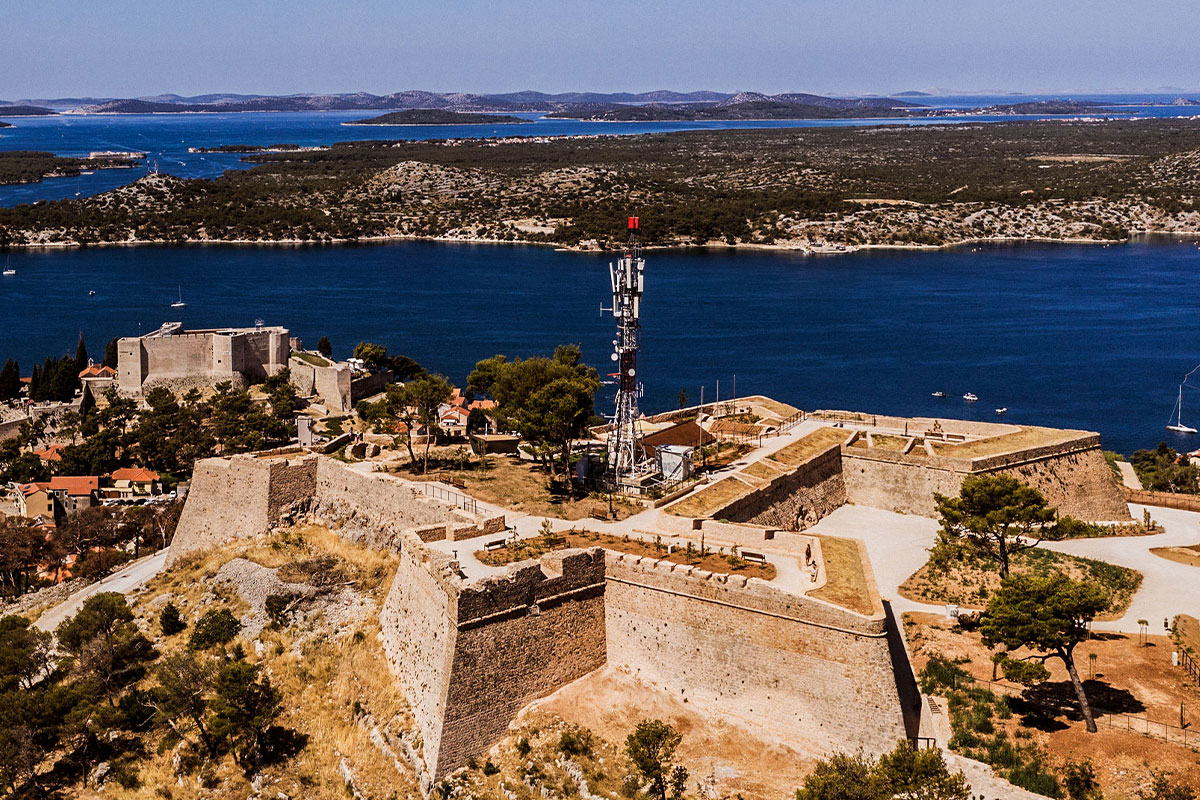
Fort St John
St. John's Fortress was built in August and September 1646 on a 120-metre-high hill north of Šibenik's town centre. It owes its name to the Church of St John, which had stood there for centuries before its construction. The citizens of Šibenik built the fortress with their own hands and resources in just 58 days according to the design of the Genoese engineer Fra Antonio Leni. Together with the nearby Barone Fortress, it formed the centre of the town's new defence system, shortly before a major attack by the Ottoman army during the Candia War.
In the peaceful centuries that followed, the fortress fell into disrepair. After a revitalisation project, the largest and most complex land fortress in Šibenik was officially reopened to the public in June 2022. In the course of the revitalisation of St. John's Fortress, two areas were renovated and redecorated - the northern part, known as the „pincers“, and the southern part, known as the „star“.
The centrepiece of the fortress is a new educational campus, equipped with interactive classrooms, presentation rooms and dormitories. It serves as a modern place for networking culture, education and tourism with the aim of creating content with high added value and improving the strategic management of cultural heritage. As a cultural and tourist attraction, Šibenik will successfully combine tradition and modern technology.
St John Fortress is also a popular recreational spot for locals and tourists. In addition to the magnificent view, visitors can relax in a bar or pick up lasting souvenirs of their visit in a souvenir shop. The fortress also organises various cultural events and workshops for children, who are particularly keen on a treasure hunt in the fortress, for example.

The Croatian Coral Centre Zlarin is a museum dedicated to corals and the centuries-old tradition of coral harvesting on Zlarin - the „island of corals“. Coral harvesting is an activity for which Zlarin is famous and it represents the most important cultural heritage of the island. The first written records about the coral hunters of Zlarin date back to the 15th century and the red coral branches of the Mediterranean are interwoven with the life, history and tradition of Zlarin.
The museum shows the past, present and future of the „red gold“ on four floors in this fascinating historic building. The history of coral farming is presented in an innovative and interesting way using modern technologies such as VR, AR, interactive tools and interesting kinetic sculptures.
With the opening of the coral centre, the red coral becomes the driving force behind the development of the island in a completely different way. Instead of exploitation, the attractiveness of the red coral and the need to preserve biodiversity take centre stage.
Interestingly, Zlarin is also the first plastic-free island in Croatia, thanks to an initiative that has prompted many to reflect and change their habits and give up single-use plastic.
The museum also serves as a venue for film screenings, workshops, book presentations and more, making it a centre of cultural life on the island.

The House of Art Arsen is located in the city centre, right by the harbour, in the renovated hall of the former Odeon cinema. The building was designed by Zlatko Neumann in the 1950s, one of the greatest protagonists of Croatian modern architecture. The Odeon cinema was opened in 1961 and was in operation until the end of the 1990s. Extensive refurbishment began in 2013.
The Haus der Kunst Arsen opened in 2021 and is now a place where cultural and educational programmes take place all year round for audiences from „7 to 77“. Cinema screenings, concerts, events for children, dance performances, exhibitions, multimedia art and audience development programmes delight the many guests.
The hall in the House of Art Arsen is a unique space in Croatia, thanks to its modular floor, which allows for quick and easy reconfiguration of the space. The almost limitless possibilities for adapting the interior design offer the opportunity to implement a wide variety of programmes, whether for cultural and artistic content or for hosting private events. Bar Arsen is an integral part of the building and is open daily during regular opening hours.
Guided tour St Michael's Fortress

Guided tours in Croatian and English are available for organised groups by prior arrangement and reservation. The group is led by employees of the cultural fortress, who are certified tour guides and accompany the visitors on a 30 to 45-minute tour.
Visitors learn who the fortress is named after, who lived in the fortress and what the underground water tanks and bread oven were used for. They are shown the oldest fortress wall and told about some exciting events, such as the explosion in the gunpowder room. Visitors are also briefly introduced to other fortresses that can be seen from the walls of St Michael's Fortress.
Finally, the guide jumps to the present day and reports on the open-air theatre and the concerts that take place here.
Guided tour Barone Fortress

Guided tours in Croatian and English are available for organised groups by prior arrangement and reservation. The group is led by employees of the cultural fortress, who accompany the visitors as certified guides on an approx. 30-minute tour.
Visitors learn how the fortress was built, who it is named after, who lived in the fortress and why. They are encouraged to take an AR tour to see what life was like in Šibenik in the 17th century.
Visitors are briefly introduced to other fortresses that can be seen from the walls of the Barone Fortress and meet prominent historical figures and inhabitants of Šibenik.
Guided tour St John Fortress

Guided tours in Croatian and English are available for organised groups by prior arrangement and reservation. The group is led by employees of the cultural fortress, who accompany the visitors as certified guides on an approx. 30-minute tour.
The tour takes place in the southern part of the fortress, the so-called „star“. Here, visitors can learn about the construction of the fortress and the fierce Ottoman attacks from the hinterland and also discover where St John's Church was located. The guide then takes visitors to the machine gun nest (bunker) from the Second World War, which is located in the western part of the fortress. The tour ends in front of the gunpowder depot, which has now been converted into a souvenir shop.
It is possible to extend the tour to the northern part of the fortress, in which case it lasts up to 60 minutes.
Guided tour Croatian Coral Centre Zlarin

Guided tours in Croatian and English for organised groups are available by prior arrangement. The tour is led by an employee of the Coral Centre and lasts approx. 45 minutes.
The tour follows the past, present and future of the „red gold“, which is presented on four floors of the museum. It begins on the ground floor with ancient history - the legend of the origin of coral and the beginning of life on the island of Zlarin. From here, visitors can follow the centuries-old tradition of coral harvesting, learn about the everyday life of the islanders and see how the corals are treated today. The tour ends on the top floor of the museum, where visitors can learn about the important role that corals play in the preservation of marine life and biodiversity.
Tour House of Art Arsenic


The Haus der Künste Arsen is open to all visitors during regular opening hours (no admission charge); tickets for the programmes are sold separately.
Visitors are welcomed by hosts who give them more information about the house and the person it is named after - Arsen Dedić (Croatian poet, musician and composer, born in Šibenik). Visitors can explore an area dedicated to this great artist: a wall with portraits of Arsen, photos and drawings by famous Croatian authors, his most famous quotes, books, poems and a bust of Arsen made by the famous Croatian musician. When no events are taking place, visitors can take a look in the main hall.
The town of Šibenik was first mentioned in 1066 in a document of the Croatian King Petar Krešimir IV. It had developed on the coast below the rocky hill, which had been a fortified observation point since pre-Roman times, well positioned to control the sea access to the Bay of Šibenik and further along the Krka River to the hinterland.
From the 12th to the 14th century, Šibenik came under changing rule (Hungarian-Croatian kings, Venice, the Byzantine Empire). The loose central government enabled the development of an urban commercial elite and the establishment of a communal system not dissimilar to that prevalent in Italian cities of the same period. The citizens retained their autonomy and escaped the fate of being a feudal estate. In 1298, Šibenik also became an independent bishopric. After a three-year siege, Šibenik signed a „protection treaty“ in 1412 and joined the Republic of Venice. The Venetian rectors ruled and supervised the town for the next four centuries.
Šibenik's fortifications today comprise four fortresses and several ruins dating from the Middle Ages to the 20th century. The oldest fortress, which towers over the old town, is St Michael's Fortress, named after the (former?) Church of St Michael. The archangel had been the patron saint of Šibenik since the Middle Ages, and this church was the oldest in the town until it was destroyed by the Austrian army at the beginning of the 19th century. From its beginnings as an Illyrian and early medieval outpost, the fortress developed into an irregular rectangle that took its final shape in the first decades of Venetian rule. One of the most interesting features is a rare example of the strada di soccorso, an escape route that connected the fortress to the coast. It was built by the Venetians in the 1420s. The city walls, which already existed in some form in earlier centuries, were completed and perfected by the Venetians in the mid to late 15th century.
The bay of Šibenik is connected to the open sea by a somewhat narrow (150-300 m), 3 km long St. Anthony's Channel. The medieval sea defences were based on two opposite fortresses on the eastern side of the channel, one of which is still clearly visible. In the mid-16th century, under pressure from the growing Ottoman naval power, the Serenissima had a series of coastal fortresses built. One of these - the fortress of St Nicholas - was built on a small island at the western entrance to the canal. Its unique layout and architectural details are one of the reasons why it was inscribed on the UNESCO World Heritage List in 2017 along with other Venetian fortresses.
In the 16th and 17th centuries, the border with the Ottomans was only a few kilometres inland. The medieval fortifications of Šibenik were not well adapted to the artillery warfare that developed during this period. With the outbreak of a new war in 1645, the town faced a major challenge. A large Ottoman army advanced into Dalmatia and threatened the towns there. The citizens of Šibenik took the initiative and began building a new fortress on the nearby St John's Hill above the old town. The Venetian officials helped, and in just 58 days the attackers had a new defence at their disposal. The siege in 1646 was repulsed, as was the one in the summer of 1647, although it was larger and better prepared. In the following 10 to 15 years, the fortress of St. John - the centre of the new defence - was rebuilt and enlarged. The Barone fortress, 250 metres to the south-east, guarded the eastern entrance to the town. Several fortified moats and redoubts were built around the suburbs. Two large bastions were added to the city walls.
With the decline of Ottoman power in the early 18th century, the fortresses lost their importance. The Venetian Republic was dissolved in 1797, and after the Napoleonic Wars, Dalmatia was incorporated into Austria. The Barone fortress was soon abandoned, but the Austrians kept the other three fortresses. Šibenik, together with Pula and Kotor, became an important town for the navy. The Austrians began building concrete fortresses and bunkers, which continued until the middle of the 20th century.
During the Croatian War of Independence, Šibenik was an important strategic point and was besieged by the Yugoslav People's Army. The Croatian armed forces stubbornly defended Šibenik. During the Battle of Šibenik from 16 to 22 September 1991, many historic buildings were damaged. The fortresses were then - we hope - used for the last time.


Architecture
The fortress of St Michael
was built as a lookout point over the Bay of Šibenik and the mouth of the River Krka and as a refuge for the surrounding population. The position has been used as a fortress since pre-Roman times, but nothing remains of these early walls. Archaeological finds from Roman, late antique and early medieval times have also been unearthed at the fortress. From the 11th century onwards, this place became the nucleus of the town of Šibenik. As a central point of defence, the fortress was often besieged and attacked, but also repaired and rebuilt.
St Michael's Fortress is a monument whose complex historical development is visible in its present state. The central part of the fortress is a castle, an inner courtyard surrounded by towers and connected by a high wall. The castle is surrounded on all sides by further fortifications. To the north-east of the castle, towards the fortress of St. John and along the entire south side towards the town centre, there are two faussebrayes. These frontal areas were built as an additional obstacle for the enemy to prevent an easy approach to and minelaying of the walls. They were well connected to the castle and other areas of the fortress, as rapid communication was necessary. In the 16th century at the latest, a large artillery platform (armoury) was built in the north-west. The platform was bordered by two towers, one of which has been preserved. Next to the second, demolished tower is a recently discovered fortified position that controlled the coastal suburb of Šibenik.
The double walls (strada di soccorso) connected the fortress to the coast. From a historical point of view, some other spaces were included in the fortress complex, such as the Madonna Tower (cavalier), a high platform built in 1639 to the south-east of the castle, or the defence wall to the fortress of St. John, built in 1657. In general, the castellan of the fortress directly managed almost one hectare of walled structures, variously levelled areas and interior facilities.
Barone Fortress
was built in 1646 on the 80 metre high Vidakuša hill above the town and financed by the citizens of Šibenik after several requests for help from the Republic of Venice were rejected. In the spring of 1646, the Ottomans began to gather their army in Bosnia and the Dalmatian hinterland. On 1 August 1646, under the leadership of Baron Christoph Martin von Degenfeld, the construction of the new Šibenik defence system began. The work was completed in just 58 days. Barone was originally a redoubt, a smaller fortress that guarded the entrance to the town. In 1659, the fortress was extended and expanded under Antonio Bernardo (Governor of Dalmatia). Half bastions with thick ramparts were added to the northern wall. A new main entrance was built, and in the southern part, facing the town, ancillary facilities were constructed.
St John Fortress
was built in 1646 on a 120 metre high hill north of the old town of Šibenik. It was also built in just 58 days as the main point of the town's new defence system, shortly before a major attack by the Ottoman army. The fortress was built by the people of Šibenik with their own hands and means according to the design of the Franciscan engineer Antonio Leni from Genoa. This first version of the fortress had the shape of a „star“. A tenaille was erected on the north side to control the terrain. Only a few days after its completion, the first attack took place and in the following summer another with tens of thousands of soldiers. This was followed by a month-long siege, during which the St John's Fortress in particular was severely damaged by Ottoman fire. Nevertheless, the defences held firm.
The fortress of St John is a complex fortress monument that was extended and adapted several times in the early decades. Antonio Leni's first work on the cramped and almost improvised fortress began almost immediately after the defended siege in 1646, and the fortress was then considerably extended to the north and west. After the second siege, the damaged fortress bastions were reconstructed with tufa and further extended. The outer fortifications to the north and west were also rebuilt several times between 1647 and 1664. The original tenaille and some secondary fortification elements were finally replaced by a series of three successive hornworks. Since then, the main contours of the fortress have not been altered. The fortress of St John was connected to other fortifications in the city by lines of defence.
From 2012, the fortresses of St Michael, St John and Barone were extensively renovated and transformed into modern adventure sites with a variety of leisure, adventure and educational functions. This was made possible by EU funding. The fortresses are now managed by the public organisation „Fortress of Cultura Šibenik“ whose sustainable approach to heritage conservation and event organisation is best practice in the development and management of fortified monuments in Europe.
It is important to mention that in addition to the three fortresses described above, there is a fourth fortress on the territory of the city of Šibenik, which is run by the public institution Nature of Šibenik-Knin County is managed: The fortress of St Nicholas.
It was built on the island of Ljuljevac and guards the entrance to the St Antoniu Channel from the Adriatic Sea into the Bay of Šibenik. Designed and built in the 16th century by the Venetian architect and master builder Giangirolamo Sanmicheli (nephew of Michele Sanmicheli), the Fortress of St. Nicholas is one of the most valuable and best preserved examples of defensive architecture in Dalmatia. Armed with 32 cannons, the brick building with stone foundations has served various armies over the centuries and has been renovated several times. Since 2017, the Fortress of St. Nicholas has been a UNESCO World Heritage Site as part of the defence system of the Republic of Venice between the 16th and 17th centuries.


The walk along the promenade in St. Anthony's Channel is about 4.4 kilometres long and is designed in the natural harmony of the nature reserve. The walk along the entire promenade takes about two hours and is a great experience, during which you can enjoy a breathtaking panoramic view of Šibenik and the Šibenik archipelago from several points. It also takes you to an island in the immediate vicinity of St Nicholas' Fortress.
Šibenik is also the starting point for various boat trips through the bay, through the St. Antonius Canal towards the sea, often combined with swimming, snorkelling or diving.
A short drive from Šibenik is the Krka National Park, which is known for its waterfalls, lakes and lush vegetation. The Krka River rises near Knin and flows into the Bay of Šibenik after just 72 kilometres. With hikes to the famous waterfalls, canoe trips and much more, nature lovers have a wide range of activities to choose from. The less adventurous can take a boat trip from Skradin to explore the breathtaking nature of the park.
From Šibenik, you can also take a trip to the offshore islands or the Kornati National Park. It consists of more than a thousand islands, islets and reefs, making it the densest archipelago in the Mediterranean.


Events in the Fortress of Culture Šibenik
Every year, countless events and concerts take place in the Šibenik fortresses. Browse through the event calendar of Fortress of Culture Šibenik.
Night of Fortresses
A weekend - fortress events all over Europe.

The cultural tourism event, which takes place at established monuments of cultural heritage (fortresses, forts, castles...), was organised for the first time in 2022 on the territory of Croatia, Montenegro and Bosnia and Herzegovina as a result of the joint European project FORTITUDE.
Over the past two years, the event has promoted and connected the programme at more than 45 fortress locations in 6 countries: Croatia, Bosnia and Herzegovina, Montenegro, the Czech Republic, Romania and Serbia. Night of Fortresses is part of the European Fortress Summer.
Wenn du dies siehst, nachdem deine Seite vollständig geladen wurde, fehlen leafletJS-Dateien.

Information for tour operators
Contact:
Public Institution Fortress of Culture Šibenik
Vodička 4, 22000 Šibenik, Croatia
Tel: +385 (0)91 497 5547
Mail: info@tvrdjava-kulture.hr
Web: www.tvrdjava-kulture.hr
Opening hours:
Winter:
Monday-Sunday 09.00 - 21.00
Winter:
Monday-Sunday 09.00 - 21.00
Notes:
- Free admission: members of professional organisations (ICOM), children under 7 years of age
- *The combined ticket for the 3 fortresses and the ticket for the Barone & St John fortress can be used once within 7 days of purchase.
- The AR device and audio guide can be used free of charge.
- The family ticket is valid for parents/guardians and their children under the age of 18.
- Visitor insurance is included.
 Deutsch
  English (UK)
  Français
  Italiano
  Polski
  Español
  Čeština
Schreibe einen Kommentar