
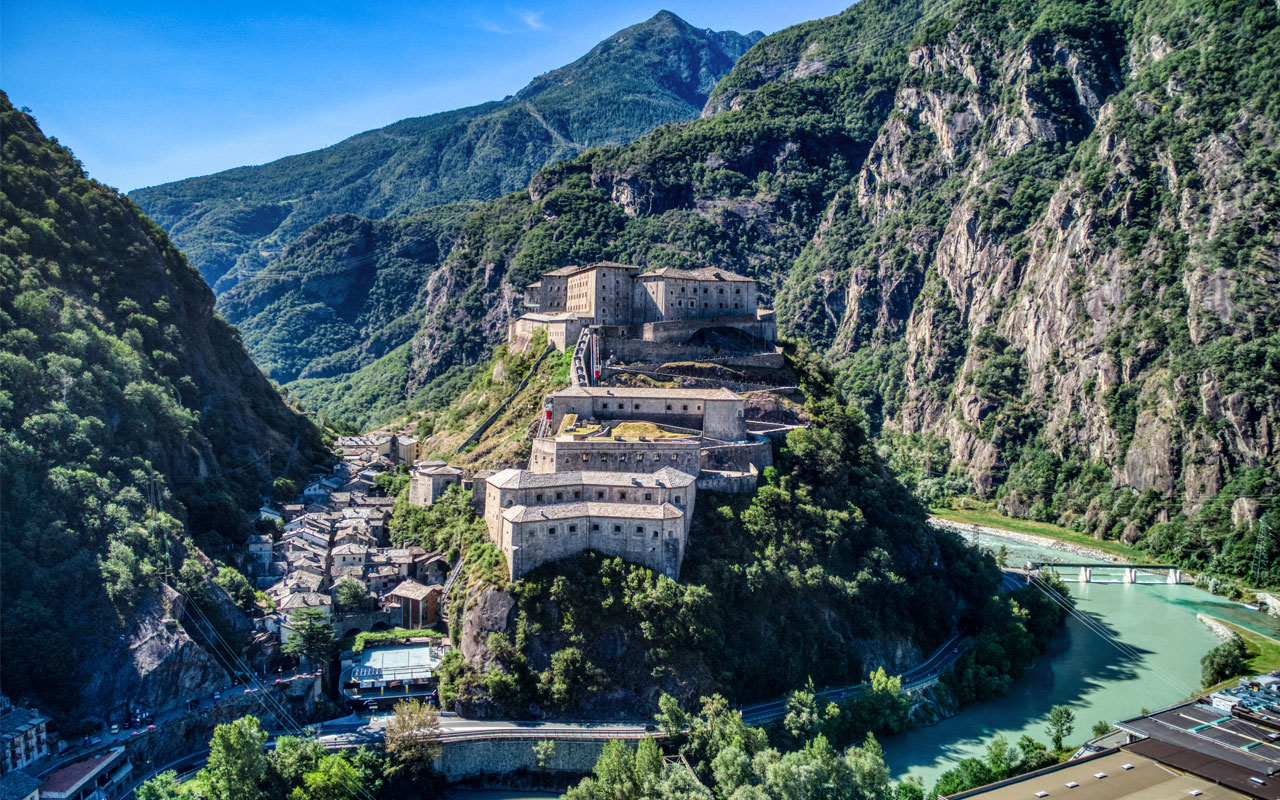
FORTE CULTURA Station: Bard Fortress (IT) - Photo ©Hagai Agmon Snir

Forte di Bard - bulwark at the entrance to the Aosta Valley

One of the best examples of fortress construction at the beginning of the 19th century

In the Dora Baltea river valley, the fortress of Bard is enthroned in the middle of a deep gorge on a rocky hill above the village of the same name. The strategic advantages of the natural features of the location were recognised early on, which is why the important access to the Aosta Valley had already been fortified since the 6th century.

Napoleon also had to recognise this when his troops tried to pass through Bard in May 1800 and were severely delayed by only 400 Austrians. On 1 June, he finally led a successful attack on the fortress himself and then had it almost completely destroyed. Carlo Alberto Amadeo (King of Sardinia-Piedmont) rebuilt the present-day fortress of Bard from the ground up between 1830 and 1838.

Today, the fortress is a jewel of fortress architecture and delights many visitors every year with its architecture, museums, modern exhibitions and events. Discover the fascinating fortress of Bard in the Aosta Valley with FORTE CULTURA.

Useful information for your visit to Bard Fortress

Forte di Bard can be explored in various ways on foot or by bike. The ideal visit can last half a day. Visitors can choose between various exhibitions and take pleasant breaks in the cafeteria or restaurant. The fort also offers the possibility of an overnight stay at the Hotel Cavour et des Officiers. It is the ideal place for families, groups and school classes and is pet-friendly.

Forte di Bard also offers special programme modules and various packages for groups.

Also: combined tickets with Aosta Valley Card (on the respective exhibition area), Apc (Association of Caravan and Motorhome Manufacturers), Assessorato ai Beni Culturali Regione Valle d'Aosta, Associazione Maestri di Sci Valle d'Aosta, Crer, Cervino Winter Summer card, Fai, Fondation Barry, Mav, Slow Food Italia, Vda Pila Spa ski pass, Skyway Monte Bianco, Touring Club Italia, Trenitalia

Accessibility for people with disabilities: The entire fortress is fully accessible for people with disabilities.


Forte di Bard is a Single Fortress in the version as Mountain fortress.

Alpine Museum

The Alpine Museum is located on the first floor of the Carlo Alberto Opera House, the main building of the fortress. In 25 rooms, the history of the Alps is told in a multimedia and playful way. The museum explores the most important natural and human components of the mountain world with rooms dedicated to Alpine civilisation, flora, fauna and climate, for example.

Prisons of the fortress

The history of the fortress is vividly told in the former prison rooms. Visitors learn interactively through films, documents and 3D installations about the architectural development and significance of the fortress from the first Ostrogothic Roman garrison in the 6th century to the new construction of the fortress in 1830. The complex restoration and reconstruction of the fortress between 1996 and 2006 is also vividly conveyed.

Museum of fortresses and borders

On 2,000 square metres, the Museum of Fortresses uses models, weapons, films and exhibits to vividly convey the history of fortress construction since Roman times. Special sections are dedicated to Alpine fortifications and the Alps as a borderline and border region.

The Alps of the Children's Museum

The museum is aimed in particular at children and young people in order to develop an understanding of the dynamics of climate change and to reflect on their own behaviour in relation to sustainability. The development and current state of Alpine glaciers are analysed using augmented reality and photo comparisons, among other things.

Medieval village and the Via Francigena

At the foot of the fortress, the streets and squares of the medieval village of Bard reveal more than a thousand years of history. Valuable residential buildings from the 15th and 16th centuries have been preserved along the main street.

Associazione Forte di Bard

History of Bard Fortress

The fortress of Bard (Italian Forte di Bard, French Fort de Bard) is a fortress complex with an impressive history. Some important historical events associated with the fortress are:

  • 6th century: An Ostrogothic garrison (Clausuræ augustanæ) was located on the rocky outcrop during the reign of Theodoric the Great.
  • In the Middle Ages, the fort is often mentioned in the chronicles of famous travellers through the Aosta Valley, who were impressed by its strategic perfection.
  • In the 13th century, the fortress came into the possession of the Counts of Savoy.
  • 1704: The Savoy occupation thwarted the advance of the French army into Piedmont during the War of the Spanish Succession.
  • The fortress played an important role during the Risorgimento, the Italian unification movement. In 1800, it was destroyed by the French troops under Napoleon Bonaparte.
  • 1830-1838: The current fortress was built by King Charles Albert of Sardinia-Piedmont, who came from the House of Savoy, after the previous building was blown up and destroyed at Napoleon's instigation in 1800.
  • During the First World War, the fortress served as a prison for prisoners of war. Later, it was a military prison and then the „powder keg“ of the Italian army until 1975.
  • In the 1990s, the fortress was extensively restored and opened to the public.

Today, the fortress houses various museums and other tourist facilities, including the Museo delle Alpi (Musée des Alpes in French), which provides information about the nature and settlement history of the Western Alps. Theatre and music performances take place in the central courtyard in summer.

Architecture

The natural features of the location open up strategic advantages that were recognised and exploited as early as the 6th century. The steep rocky outcrop above the Dora Baltean river valley is easy to defend and enables effective control of the valley and the trade routes between Italy and France. In the time of Theodoric the Great, an Ostrogothic garrison (Clausuræ augustanæ) was located on the rocky outcrop.

Bard later belonged to the Counts of Aosta and then to the Lords of Bard. The fortifications on the rock were successively reinforced and extended. In the 13th century, the fortress came into the possession of the Counts of Savoy, who had a lasting influence on the development of the fortress site in the following centuries.

In 1704, the Savoy occupation thwarted the advance of the French army into Piedmont during the War of the Spanish Succession.

The current fortress was also built between 1830 and 1838 by King Charles Albert of Sardinia-Piedmont, who came from the House of Savoy. This was after the previous building on the same site had been blown up and completely destroyed at Napoleon's instigation in 1800.

Today, the fortress is characterised by its fortified walls with towers and bastions, which nestle against the rock on several terraces. The central courtyard of the fortress is surrounded by high walls and served as a meeting and recreation area for the garrison. There are various buildings within the fortress, including barracks, armouries, chapels and administrative rooms.

In the course of the extensive renovation in the 1990s, the funicular railway and panoramic lifts were also integrated, making the ascent to the fortress an experience.

One A nature experience around the Forte di Bard in Italy’s Aosta Valley combines spectacular Alpine scenery, interactive exhibitions and historic walking trails. The imposing fortress stands atop a steep rock in a narrow gorge through which the River Dora Baltea winds its way.

The fortress itself is an international cultural and nature centre, offering nature lovers fascinating insights into the natural world at the Alpine Museum, as well as world-class nature photography through international photo exhibitions. What’s more, breathtaking panoramic views of the valley and the surrounding mountains can be enjoyed from numerous vantage points across the fortress at any time of year. The panoramic glass lifts make even the ascent to Forte di Bard an experience in itself.

Where nature meets history: your outdoor adventure at Forte di Bard

Experience the untamed beauty of the Aosta Valley around the mighty fortress Forte di Bard. The spectacular alpine backdrop combines sweeping panoramic views, historic trails and geological wonders to create the perfect destination for outdoor enthusiasts. Whether you’re looking for a sporting challenge or simply want to relax and enjoy nature – here, history comes to life with every step. For those keen to conquer the peaks, the historic military trail to Col de Cou an absolute highlight. The climb is rewarded with a boundless panoramic view over the majestic Alpine peaks. Those who prefer a gentler pace can stroll along the legendary Via Francigena or the Cammino Balteo. These picturesque routes wind their way right at the foot of the fortress, through shady chestnut groves, sun-drenched vineyards and villages steeped in tradition.

As well as epic hiking trails, the region boasts fascinating natural landmarks. In the surrounding area, there are glacial potholes by the raw power of nature. In neighbouring Donnas, a real journey back in time also awaits: here you can stroll along a ancient Roman road, which was carved directly into the bare rock thousands of years ago. Lace up your walking boots and make the Forte di Bard your base camp with FORTE CULTURA for some unforgettable moments.


Events at Forte di Bard

Eventkalender der Festung Bard.


Contact us

Associazione Forte di Bard

11020 Bard, Italy

Phone: +39 0125 833811
e-mail
Website


Travelers‘ Map wird geladen …
Wenn du dies siehst, nachdem deine Seite vollständig geladen wurde, fehlen leafletJS-Dateien.

Discover European cultural routes

The fortress of Bard is also located on the VIA FRANCIGENA, a certified "Cultural Route of the Council of Europe".

"In 990 BC, Sigerich, Archbishop of Canterbury, travelled to Rome to visit Pope John XV and receive the pallium from him. On his way, he recorded 79 stages of his journey in a diary. Thanks to this document, it was possible to reconstruct the shortest route between Canterbury and Rome at the time, which can be used by all travellers today." ©www.coe.int

Via Francigena is a pilgrimage route covering 1800 kilometres through England, France, Switzerland and Italy, ending in Vatican City.


Comments

Schreibe einen Kommentar

Your email address will not be published. Erforderliche Felder sind mit * markiert