
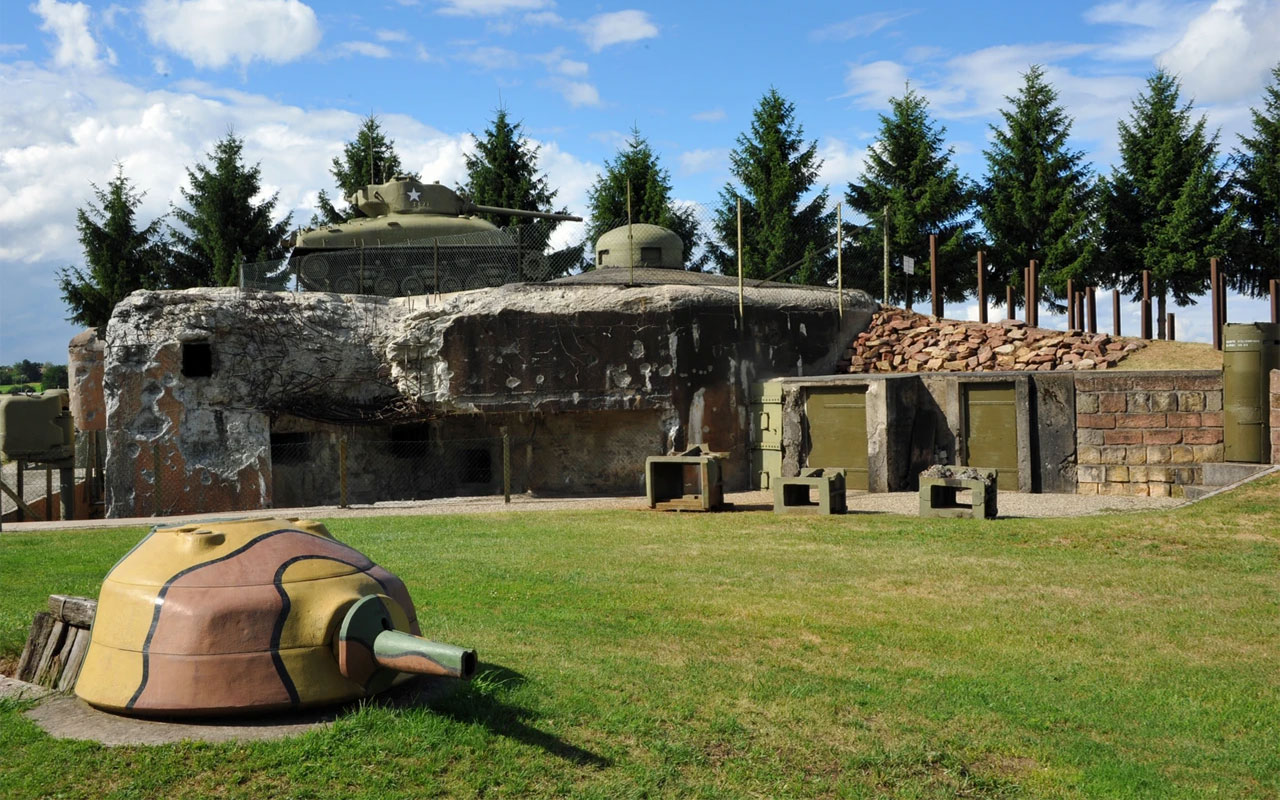
FORTE CULTURA Station: Abri Hatten (FR), fortress (large shelter) of the Maginot Line
Culture of remembrance and military history
The Maginot Line in Alsace
The „ABRI“ Hatten large shelter (Haguenau, FR) is situated approximately 50 km from Strasbourg and 40 km from Karlsruhe. Construction began in 1930 and it was used by French troops from 1936 until July 1940. A total of 28 rooms, including sleeping quarters, a kitchen, toilets, a well, an infirmary, a boiler room, an engine room, ventilation systems (a filter room to protect against gas) and close-quarters defence installations, have been restored and can now be viewed in the museum. The Abri Hatten Museum is dedicated to the memory of all victims of the period 1939–1945.
A total of 19 Maginot Line fortifications were built in the Hatten area (Haguenau, FR). Join FORTE CULTURA to explore the region’s largest „ABRI“, which could accommodate a garrison of 220 men.

Discover the Abri Hatten in Alsace:

Abri Hatten is a Military bunker from the Second World War and forms part of the Maginot Line.
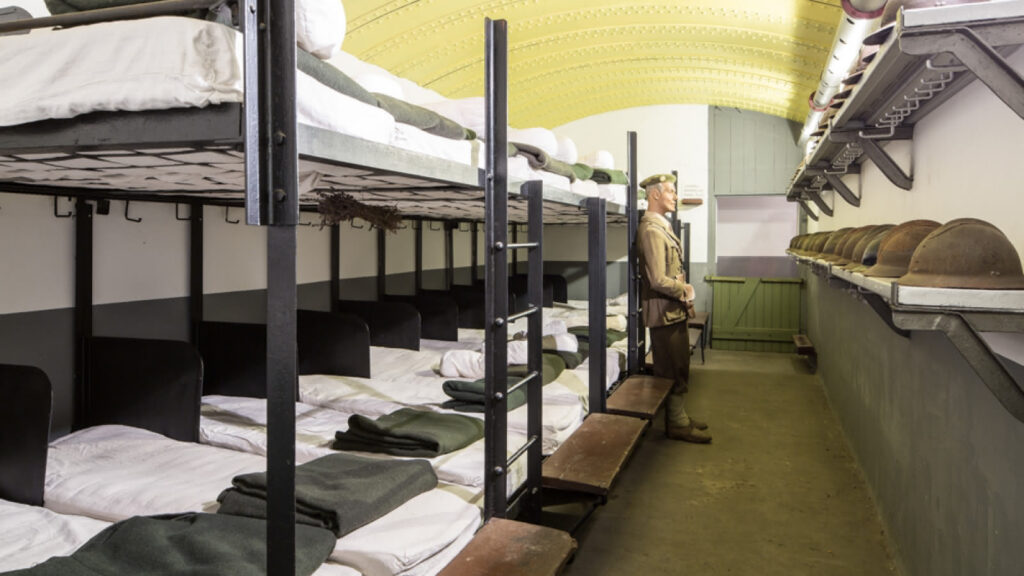
Museum Bunker
No fewer than 19 structures of the Maginot Line were built from 1930 onwards in the area around the town of Hatten, a village on the edge of the great Haguenau Forest at its eastern end. These structures include many small bunkers, as well as a beautiful OBSERVATORY (not open to the public) and, of course, the ABRI, the largest of them all with its 28 reconstructed rooms – some identical, others converted into themed exhibition spaces.
From 9 to 21 January 1945, Hatten and the neighbouring village of Rittershoffen found themselves at the centre of one of the largest tank battles in France as part of the Nordwind offensive. Both villages were 85% destroyed, and there were 83 civilian casualties in Hatten and 31 in Rittershoffen.
Several rooms at the heart of the bunker pay tribute to these victims and, through numerous photographs and testimonies from the soldiers who fought in this battle, recount the history of these two villages in turmoil. You can also learn about Operation Nordwind, which was ordered by Hitler on 1 January 1945 to give his army group, which was engaged in the Battle of the Bulge, a brief respite.
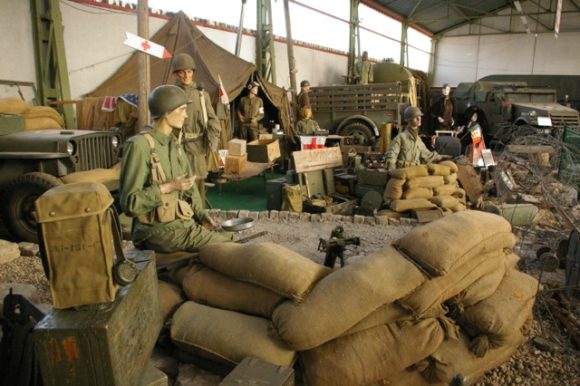
Museum grounds – exhibition halls and open-air exhibition
IOpen-air exhibition –
A wide-ranging collection of military equipment is on display around the bunker. The collection spans the period from 1939 to the present day, with items arranged according to their country of origin.
House of Models
The exhibition enables visitors to explore the various stages in the construction of the Maginot Line and the different types of fortifications. Visitors can view scale models and gain an overall picture of the Line without having to walk through the kilometres of tunnels and stairways found in the actual fortifications.
Hall of the Forcibly Conscripted
This exhibition building is dedicated to the 130,000 people from Alsace and Lorraine who were forcibly conscripted into the Wehrmacht between 1942 and 1945. If they refused, their families were threatened with deportation.
Halle 1944–1955
This exhibition hall is designed like a large stage, featuring a re-enactment of the Battle of Hatten in January 1945. The battlefield, complete with German and American military equipment, has been faithfully reconstructed and offers visitors a glimpse into the past.
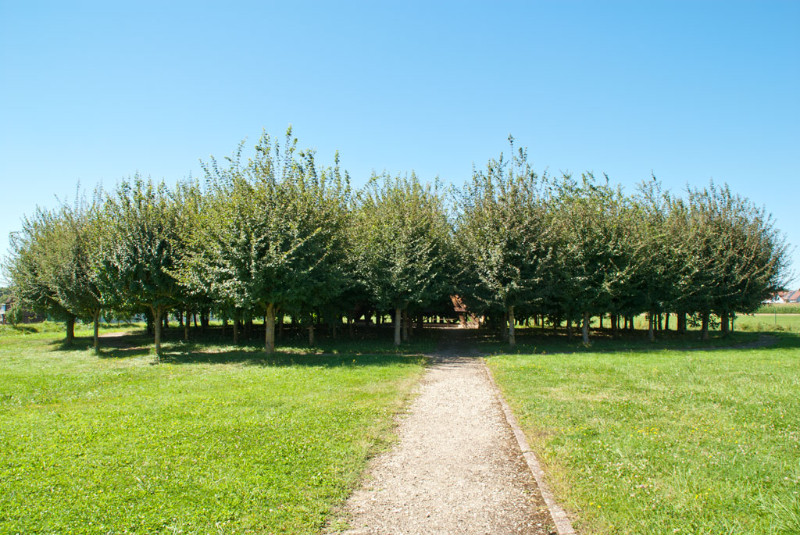
Forest of Remembrance – Bois du Souvenir
The Memorial Wood, with its 114 trees, commemorates the 114 civilian victims from the two communities of Hatten and Rittershoffen. In the centre of the copse, beneath a modern structure open to the four winds, stands the CHARETTE DU SOUVENIR. It was used to transport the bodies of hundreds of military casualties (both American and German) and civilians.
The Hatten Shelter Museum
Information and bookings for groups during opening hours:
By telephone at the museum: 03 88 80 14 90
or by email: info@abrihatten.fr.
Average duration of visit: 2.5 to 3 hours.
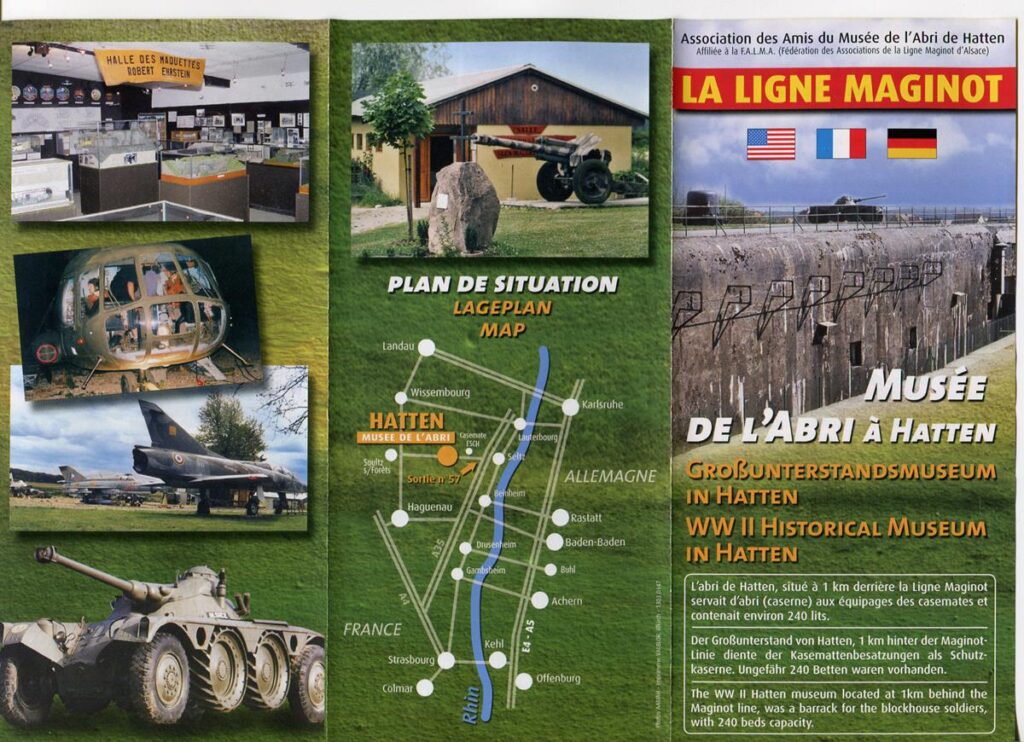
History of Abri de Hatten
The Abri de Hatten Museum is situated in a former underground barracks for French soldiers on the former Maginot Line. Some of the bunker’s 28 rooms have been restored to their original condition, whilst others are dedicated to various themes relating to the history of Hatten during the Second World War. There are also interesting things to see on the grounds surrounding the bunker complex: An extensive collection of military equipment and material from 1939 to the present day, a collection of models, a memorial to the conscripts known as the „Malgré-nous“, and a hall containing exclusively American or German material from 1939 to 1945. Scenes re-enact the battle of January 1945 in Hatten. During the ‘Nordwind’ offensive launched by Germany, German and American forces faced off against each other in and around Hatten from 9 to 21 January 1945. Hatten and the neighbouring village of Rittershoffen became the scene of one of the bloodiest tank battles in France. In the fighting between German and American tank units, 2,500 soldiers lost their lives.
Both villages were destroyed in 85%. Following fierce street fighting, Hatten recorded 83 civilian deaths, whilst Rittershoffen recorded 31. Next to the museum lies the Forest of Remembrance, dedicated to the 114 civilian victims from the two communities. It is a place of tranquillity and reflection.
Remembrance tourism and the Maginot Line – Pays de Haguenau


Architecture
Between 1928 and 1940, under the Minister of War André Maginot, one of the world’s largest contiguous fortification systems was built – the Maginot Line – which is now a national monument in France.
The Maginot Line stretches for around 700 kilometres from Belgium in the north to the Swiss border in the south. The massive major combat groups, some of which were connected by underground supply systems, as well as the numerous infantry casemates, artillery positions and intermediate fortifications, were intended to prevent German troops from invading France. Large shelter (Abris).
The shelters of the Maginot Line were „barracks bunkers“. They were usually situated 1 kilometre behind the main line of defence (HKL). There were two different types: above-ground structures (Abris de Surface) and underground ones (Abris Cavernes). Abris Surface usually also had a basement level. The Abris Cavernes had one or two entrance blocks, similar to the fortifications (ouvrages), in which the access shafts to the barracks – situated approximately 20 metres below ground – were located. The abris were constructed to accommodate mobile units between the fortifications and the casemates, as part of the CORF construction programme. The abris, situated on the rear slope, had walls and ceilings 2.5 metres thick in their above-ground sections. For defence, they were equipped with GFM armoured turrets facing the enemy, which could be fitted with light machine guns (LMG), 5 cm grenade launchers and optical devices. The close-quarters defence embrasures for the entrances were manned by LMGs. The ‘Abris Surface’ still featured the characteristic diamond-shaped trench. (Source: Jean Bernard Wahl, The Maginot Line in Alsace).
The museum has been housed in one of the Maginot Line’s large shelters. It is a barracks bunker that served as accommodation for soldiers deployed on the front line. The 28 rooms, which have either been restored to their original condition or converted into exhibition spaces, were capable of accommodating 220 people.
The fort is dug into the southern flank, which is not exposed to enemy fire. The 60-metre-long, windowless façade features two armoured doors and four machine-gun embrasures, as well as a trench running alongside the building, intended both to collect debris in the event of a bombardment and to make access more difficult. At each end of the trench, there is an embrasure and a chute for throwing hand grenades, which were intended for close-quarters defence.
The whole structure is flanked on the east and west sides of the bunker, above the trench, by two GMF (Guet Fusil Mitrailleur) turrets. These were intended for observation and close-range defence.
Visitors can explore recreated areas such as the kitchen, the infirmary, the boiler and engine room, the radio room, the commander’s office, the generators, the sanitary facilities and the crew quarters. With these facilities, the large shelter was self-sufficient.


Contact us
Hatten Shelter Museum
rue de l’Abri, 67690 Hatten, France
Telephone: +333 88 80 14 90
Fax: +333 88 80 14 90
Mail: info@abrihatten.fr
Web: https://www.abrihatten.fr/
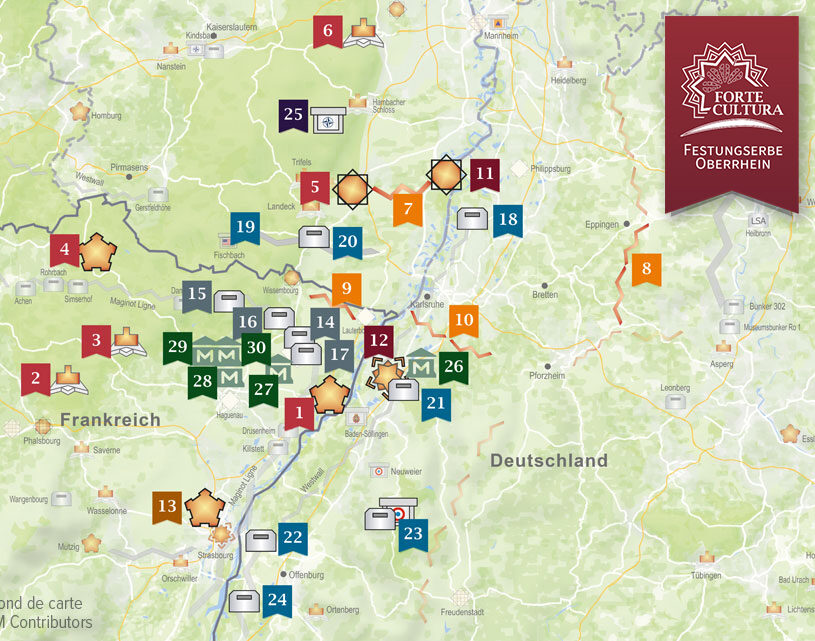
Cultural heritage
fortified monuments
of the Upper Rhine region
The Upper Rhine region is one of the most fought-over regions in Europe. Fortified monuments from all eras bear witness to this exciting cultural history. Today they are monuments full of life and culture.
Discover the history of fortress construction over the last 350 years in the 30 FORTE CULTURA fortresses and museums on the Upper Rhine.
Tourism partners of the Abri de Hatten



Wenn du dies siehst, nachdem deine Seite vollständig geladen wurde, fehlen leafletJS-Dateien.
 Deutsch
  English (UK)
  Français
  Italiano
  Polski
  Español
  Čeština
Schreibe einen Kommentar