

From the bastions of the Renaissance to the bunkers of the 20th century, the fortified cultural heritage shows how Europe responded to changing threats - and how these places can serve culture and peace today.
Cultural Heritage Fortified Monuments
At all times, rulers have conquered and subjugated foreign territories. Both the occupiers and those under threat built defences that became ever more powerful and sophisticated in the face of constantly improving weapons technology.
„Architectura Militaris“ - refers to this special fortification architecture, which has left behind an extraordinary cultural heritage spanning several millennia of European history.
From Bastions to Bunkers
FORTE CULTURA tells the story of European fortress heritage from the late 15th to the 20th century.
The „gunpowder revolution“
Gunpowder came to Europe from China in the 13th century and the first small arms and guns were created in the 14th century. The first use of „giant guns“ is documented in the case of Constantinople, which in 1453 smashed the Theodosian walls, which had previously been considered impregnable. By the time Charles VIII of France invaded Italy in 1494 with a highly mobile, horse-drawn artillery force, it was clear that fortress construction would have to change radically in order to be able to hold its own.
Medieval walls and towers had to make way for new forms of defence: low profiles, space for cannon positions, thick earth ramparts behind layers of brick, protruding bastions, geometric layouts to avoid blind spots, wide and deep ditches and much more. This resulted in complex bastioned fortification belts around castles, religious buildings and towns. Entire military fortified towns were designed and built at strategically important locations.
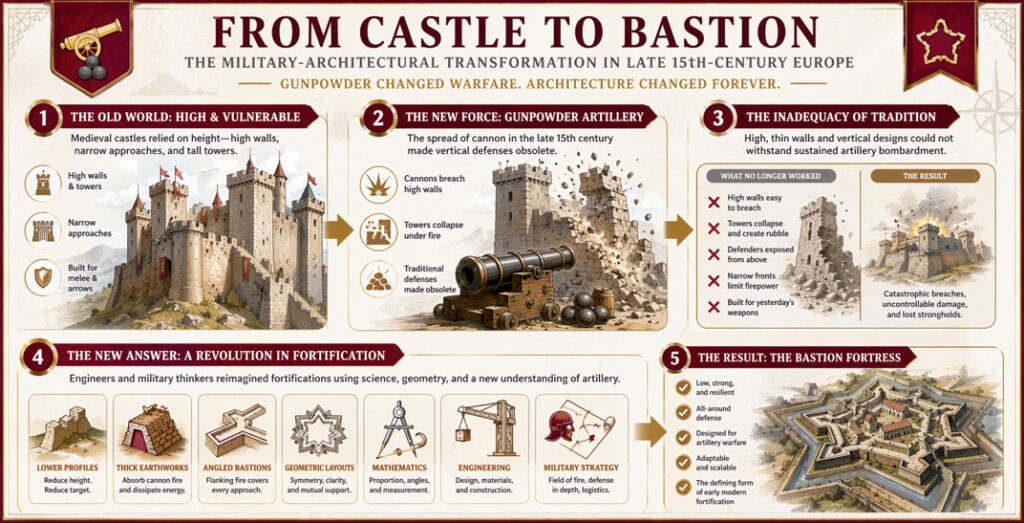
In the following centuries, military architecture continued to develop. Fortresses were increasingly characterised by science, influenced by geometry, ballistics, topography, engineering schools and military academies.
Explosive grenades and reinforced concrete
In the industrial age, the new explosive melinite was used to create explosive grenades with impact fuses, which had such a devastating effect on bastion fortifications that they were immediately considered obsolete.
Once again, fortress construction had to reinvent itself. Fortifications were decentralised, reinforced with reinforced concrete and increasingly built underground. The Fortresses of the 20th century were bunkers, bunker systems and elongated defence lines of the First and Second World Wars. After the use of the atomic bomb in 1945 and the beginning of the Cold War, increasingly high-tech government bunkers were built all over Europe.
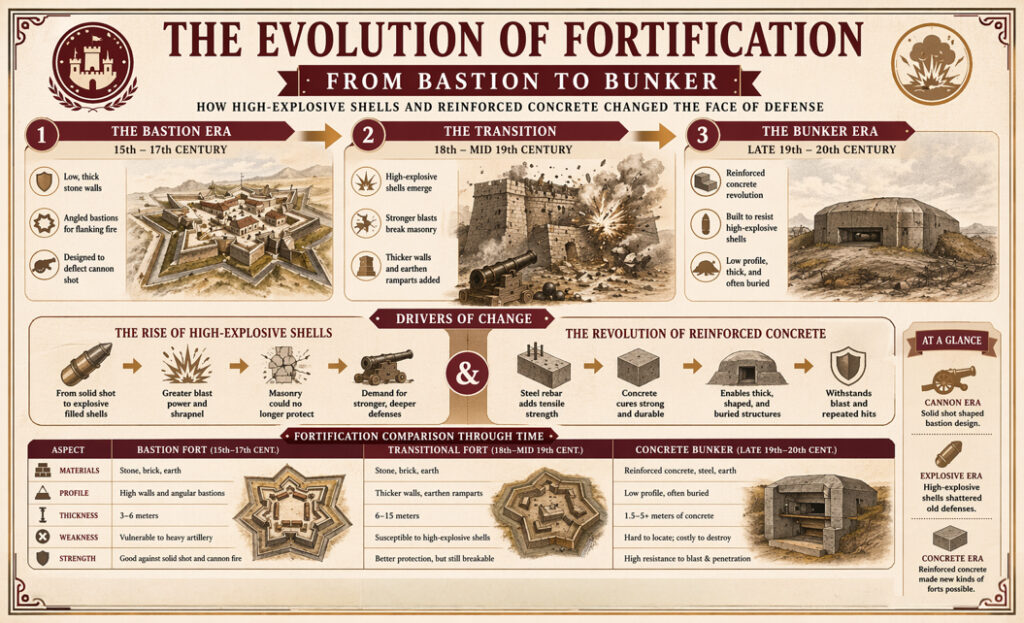
FORTE CULTURA interprets this long transformation as a technological and cultural continuum. It is not a succession of individual epochs, but a European history of adaptation, inventiveness, conflict, memory and reuse.
 Deutsch
  English (UK)
  Français
  Italiano
  Polski
  Español
  Čeština