
FORTE CULTURA Stop: Argotti Botanic Garden, Malta (MT)
Between bastions and blossoms: The Argotti Botanic Gardens in Malta
Set within the historic fortifications of Floriana, the Argotti Botanic Gardens & Resource Centre offer a unique insight into Malta’s green and military past.
As a FORTE CULTURA site, they impressively combine the European cultural heritage of historic fortresses with a vibrant experience of nature and science. At St James’s Bastion, nestled within the Floriana Lines defences just outside the gates of Valletta, it becomes clear just how closely fortress construction, urban history, garden design and botanical research are intertwined in Malta.
Visitors will discover not only the island’s most significant botanical garden, but also a special place of remembrance, where walls, bastions, historic gardens and a wealth of Mediterranean plant life all tell the story of the Mediterranean region’s eventful history. This stop invites visitors to experience fortress culture from an unusual perspective: not merely as a military structure, but as a cultural landscape that has evolved over time, where defence, representation, education and recreation continue to coexist to this day.
Between the historic entrance gate, the ornate Nymphaeum Grotto, themed plant collections and sweeping views across Floriana, an atmospheric walking tour has been created that combines the enjoyment of nature, historical context and tourist discovery. For the FORTE CULTURA network, the Argotti Botanic Gardens are thus a vivid example of how former military sites can be repurposed, presented to the public and transformed into attractive destinations within Europe’s fortress heritage.
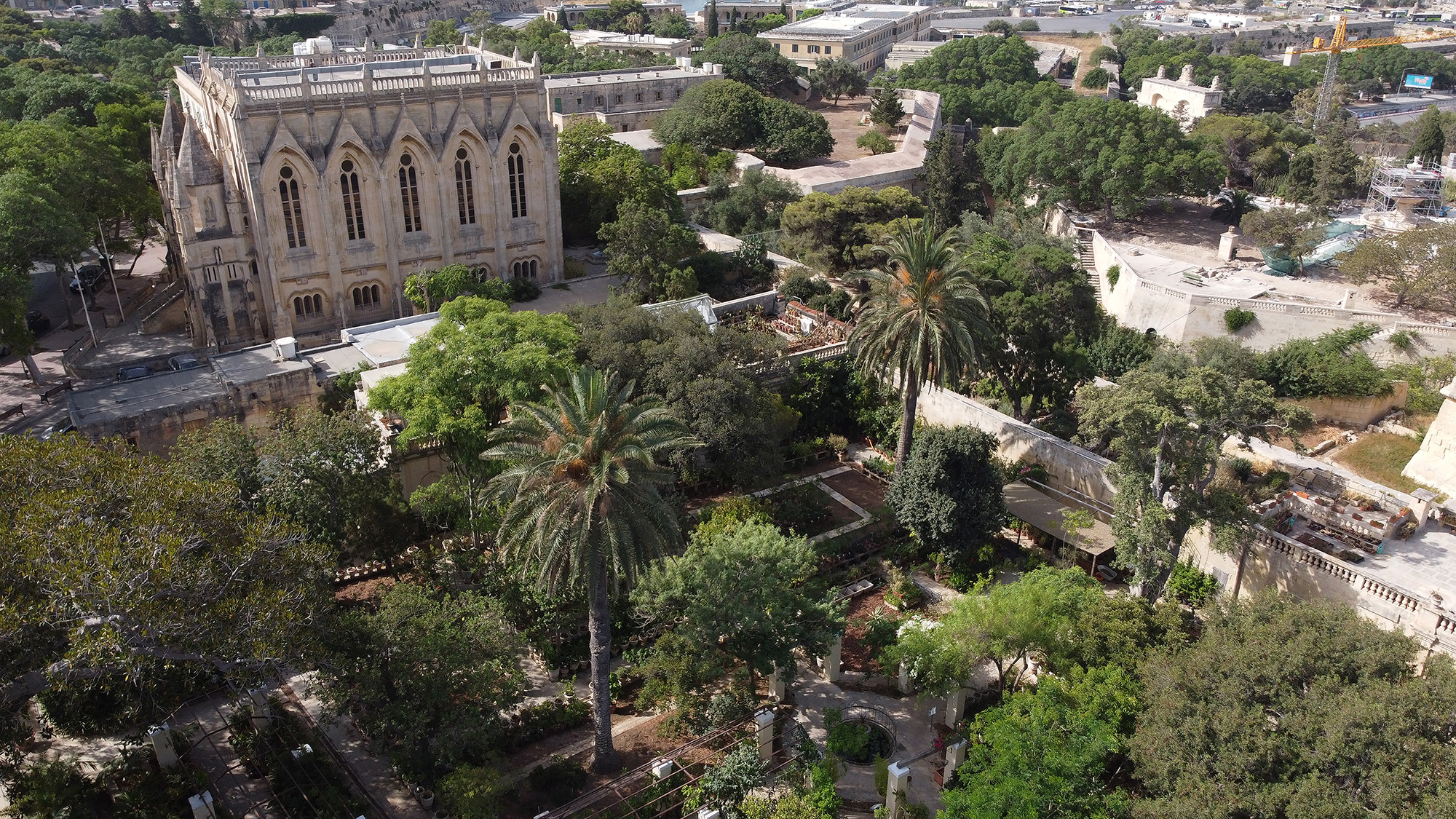
Cover image: A bird’s-eye view of the Argotti Botanical Garden. The building in the background is not part of Argotti, but is the Robert Sammut Hall (which is used by the National Orchestra). During the British colonial period, Argotti’s palace was demolished to make way for a Methodist church (although the building you can see now is no longer used as a church). A garden can be seen in the top right-hand corner. This is St Philip’s Garden, situated on St Philip’s Bastion.

Discover Argotti Botanic Gardens in Malta know:

The Argotti Botanic Garden is situated on a bastion of the fortified city of Valletta in Malta.

History of the town and its founder
At the suggestion of Pope Urban VIII, Grand Master Antoine de Paule commissioned the Italian military engineer Pietro Paolo Floriani to design additional fortifications for the capital, Valletta.
This led to the construction of the Floriana Lines, including St James’s Bastion, on which the Argotti Gardens were later laid out.
The gardens on St James’s Bastion originally belonged to the Bailiff of Acre, Don Emmanuel Pinto de Fonseca, and the Bailiff Ignatius de Argote y Gusman. When Pinto was elected Grand Master of the Order of St John in 1741, Argote acquired the entire estate. Argote had a new gate built for the gardens, which still serves as the main entrance today.
He also built an ornamental grotto, known as the „Nymphaeum“, the interior of which was once entirely lined with rustic rocks, pieces of red coral, calcite crystals, shells and colourful pebbles.
In 1674, Dr Giuseppe Zammit laid out a medicinal herb garden in the moat of Fort St Elmo, known as „Il Giardino dei Semplici“. The collection of plants was eventually moved to various gardens in Floriana, until, in 1855, under the supervision of Stefano Zerafa, Professor of Natural History, it found its permanent home in the Argotti Gardens. This marked the beginning of the site’s history as the Argotti Botanical Garden.
The site’s fortification architecture
The Argotti Botanical Gardens are situated directly on the 17th-century St James’s Bastion, a key defensive element of the outer fortifications known as the „Floriana Lines“, which were designed to protect Valletta. Visitors can see how the botanical gardens blend with the historic masonry, including original architectural features such as the 18th-century Argotti entrance gate and the ornate Nymphaeum Grotto.


The Argotti Botanic Gardens & Resource Centre on St James’ Bastion are Malta’s most important botanical gardens and are maintained by the University of Malta. The plants are organised by family and into themed displays. Highlights include:

The Citrus Garden
A dedicated section showcasing traditional Maltese citrus varieties.

The Mediterranean Garden
An area of the garden dedicated to the local flora and designed to mimic its natural growth. This part of the garden is situated on the wall between St James’s Bastion and St Luke’s Bastion. Here, visitors can see how native plants have adapted to the dry summers typical of the Mediterranean climate.
The gardens are open to the public according to the following timetable:
Thursdays (guided tours): 9.30 am – 11.00 am;
Mondays, Wednesdays and Fridays (on an individual basis): Admission at 9.00 am or 11.00 am
An audio guide is available via the „Walk with Willa“ app (https://walkwithwilla.com/) available.
Admission price: €5 per person
Group visits: Please send by email to argottigardens@um.edu.mt be agreed.
Programme for the school year
We are delighted to be able to offer pupils in Years 1 to 11 a wide range of educational and interactive activities. Through guided tours and hands-on activities, pupils can discover the fascinating world of plants against the unique backdrop of the Argotti Botanic Garden.
events
23, 25 and 26 September 2026
In collaboration with the Malta Festival of Ideas and Science in the City, Plant-e is organising a panel discussion and exhibition entitled „From photosynthesis to the electricity grid: harnessing the energy of plants“.
Link: https://www.facebook.com/reel/1050963730677871
18 October 2026
Guided tours of the garden and a plant sale, organised in collaboration with the Floriana local council (Ġenna ta‘ Ġonna).
Link: https://www.florianalocalcouncil.com/event/genna-ta-gonna-2026/
Contact us

Argotti Botanic Gardens & Resource Centre
Triq Vincenzo Bugeja, Floriana, Malta, FRN 1553
Telephone: +356 2340 7875
Email
Website
Curator’s email address: Christian Borg
Wenn du dies siehst, nachdem deine Seite vollständig geladen wurde, fehlen leafletJS-Dateien.
 Deutsch
  English (UK)
  Français
  Italiano
  Polski
  Español
  Čeština
Schreibe einen Kommentar