

FORTE CULTURA Station: Vyšehrad Fortress (CZ)
Vyšehrad Fortress Prague - National Cultural Monument
Impressive history and legends high above the Vltava
The history of the Vyšehrad fortress in Prague is closely linked to the development of Prague's districts and the history of the Czech nation. The mighty rock rising high above the Vltava was already an enticing location for settlements in ancient times and became the subject of many legends.
The mysterious rock above the Vltava River has always attracted people's attention. Old Czech legends are associated with Vyšehrad. It was Prague's point of defence from the south, a royal castle, royal papal chapter, collegiate chapter, fortress and independent town. Today's appearance shows the development from a medieval castle to a baroque citadel to a national symbol.

Discover the Vyšehrad fortress in Prague on the Vltava river:

Prague Vyšehrad is a Fortress within the fortress city of Prague.

Vyšehrad Fortress
Vyšehrad has changed its function and appearance several times. It was a royal castle, and for a short time even the seat of a monarch. It became a town and later a Baroque fortress, the appearance of which it has retained to this day. At the end of the 19th century, Vyšehrad became a national symbol and the cemetery for the most famous Czechs.
Today, Vyšehrad is a popular destination for walks with breath-taking views of the city and a number of significant monuments. Vyšehrad has many faces, come and see them all!
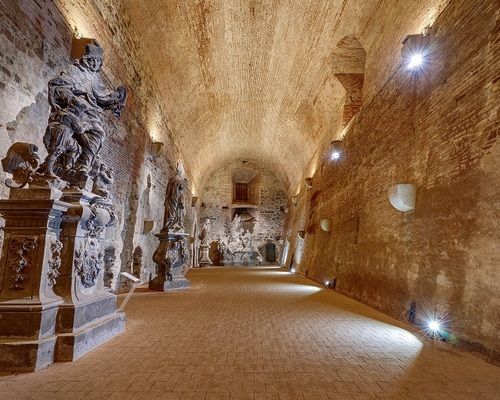
Casemates and the Gorlice Hall
The 12-metre-high Gorlice Hall (1656 – 1678) is the largest casemate in Vyšehrad, following the alteration of the shape of the Saint Bernhard Bastion. Today, it houses six of the original Baroque statues from Charles Bridge.

Leopold Gate, Tabor Gate, Brick Gate and Špička Gate
The Leopold Gate (1672) was the representative main entrance to the Vyšehrad Citadel until the construction of the brick gate.
The Empire-style brick gate (1841) presents the development of the history of Prague and its fortifications in a 3D model as part of a modern audiovisual exhibition. It is also the starting point and ticket office for guided tours of the casemates and the Gorlice Hall.
The Tabor Gate (1640) near Vyšehrad underground station still shows traces of its former portcullis and arrow slits.
The Gothic Špička Gate with its spice store was demolished in the late 18th century. The surviving parts now house an information centre with tourist material, merchandise, refreshments, ticket sales and a meeting point for guided tours.

Gothic cellar
The large subterranean room is the remains of one of four palace buildings from the time of Charles IV. It houses a narrative exhibition presenting Vyšehrad in its various historical forms. Trace the myth of Vyšehrad and its significance for national identity.

Redan – Artillery Redoubt with Open-Air Stage
The site of the so-called Redan was constructed in 1849-50 as an advanced position for the mortar bombardment of the city. It was built by the Vienna government in response to the suppressed uprising in Prague in June 1848.
Guided tours of the Vyšehrad Fortress Prague
Take part in guided tours and discover the diverse stories, secrets and interesting facts that still echo in various locations around Vyšehrad Fortress.
Exhibitions in Vyšehrad Fortress Prague
Vyšehrad served as a princely and royal residence, a symbol of sovereign power, a spiritual centre and a protector of the Prague towns. Learn about its history through various exhibitions.

Vyšehrad Audio Guide
Discover the Vyšehrad Fortress with a digital travel guide entirely at your own pace. The routes will lead you to the main sights, hidden corners and mysterious underground passages. Simply download the free SmartGuide app and turn your phone into your personal tour guide. Many language versions are available. Instructions on how to download and use the digital travel guide can be found further down this page.

History of the Vyšehrad Fortress Prague
The history of Vyšehrad is closely linked to the development of Prague's districts and the history of the Czech nation. The mighty rock rising high above the Vltava River was already an enticing location for settlements in ancient times and became the subject of many legends. However, the first reliable evidence of the existence of a hill fort at Vyšehrad only dates back to the mid-10th century, when the denarius coins of Boleslaus II were minted here.
Since then, Vyšehrad has changed its function and appearance several times. It was a royal castle and for a short time even the seat of a monarch. It became a town and later a Baroque fortress, an appearance it has retained to this day. At the end of the 19th century, Vyšehrad became a national symbol and the burial ground of the most famous Czechs. Since 1866, the Vyšehrad fortress in Prague has been a national symbol of the earliest history of the Czech people. The hill is a popular destination for walks offering breath-taking views of the city and a number of significant monuments.
Architecture of Vyšehrad Fortress Prague
Construction of the Vyšehrad fortress in Prague, designed by General Innocenzo Conti and Josef Priami, began in 1653. Even before construction started, the Tábor Gate with the adjoining angled rampart had already been completed on the Pankrác side in 1639.
A massive brick fortification with the ground plan of an irregular pentagon, from the corners of which five bastions protrude, was completed around 1727. The new fortress included the Baroque Leopold Gate (1669) and a sophisticated network of casemates – underground passages for the rapid deployment of soldiers and the storage of equipment. Most of the older buildings were demolished and the Vyšehrad Chapter was temporarily abandoned. An impressive armoury was built on the former royal acropolis. However, it burned down in 1927 and was never rebuilt.
The Vyšehrad Fortress was never used for a military campaign against Prague. On the contrary, during the Wars of the Austrian Succession, the fortress was used as a base by the French army and later by the Prussian army. The final reconstruction of the fortress took place in the mid-18th century, when the Empire-style Brick Gate (1841) and the redan, a cannon firing position on the city side, were completed.


The parks of Vyšehrad began to take on their current form in the 1880s as the military importance of the fortress declined. The Vyšehrad Cemetery was expanded and rebuilt into a national cemetery, the first composite parks were laid out, and avenues of horse chestnut and black locust trees were planted along the paths and fortress walls. The fortress slopes were leveled, seeded with grass and planted with shrubs. Roads were laid out on the bastions, and the newly accessible bastions allowed for sweeping views of the landscape through the development of the road network. The hills of Vyšehrad were planted and redesigned according to the design of František Thomayer (now Libušinka). A decisive role was played by the figures of the Vyšehrad Chapter, Provosts Štulc and Karlach, who drove the construction and general development of the Vyšehrad area. Two of Vyšehrad's parks are named after them. At the beginning of the 20th century, the city bought the Vyšehrad area from the military and turned Vyšehrad into a recreation area. In 1962, Vyšehrad was declared a national cultural monument and has since been managed and developed in accordance with the principles of heritage conservation.
The parks of Vyšehrad are largely uncomposed. They are defined by promenade paths with viewpoints, historic tree-lined avenues, expansive lawns and groups of flowering shrubs. Thanks to the varied relief, both generous lawns bathed in sunlight all day stretching to the fortification ring with views in all directions and shady, damp and quiet corners, bordered by slopes with an almost forest-like character, have been created.
The landscaped parks are particularly noteworthy: the Štulc Gardens, the Karlach Gardens and the Ducal and Royal Acropolis. The children's playground „Old Bohemian Legends“ is located in the Small Garden on the hill opposite the Rotunda of St Martin. Next to Vyšehrad, the Botanical Garden of the Faculty of Science of Charles University was opened in 1898 and gradually expanded to include an arboretum, ponds, greenhouses and a large alpine garden.


Events in the Vyšehrad Fortress Prague
The Vyšehrad Fortress Prague is a place of living culture for all generations. The programme includes music evenings, theatre performances, fairy tales for children, lectures, social events and numerous festivals. Historical anniversaries or the popular fencing day are further programme highlights. Discover the with FORTE CULTURA Events in the Vyšehrad Fortress Prague.
Contact us

Wenn du dies siehst, nachdem deine Seite vollständig geladen wurde, fehlen leafletJS-Dateien.
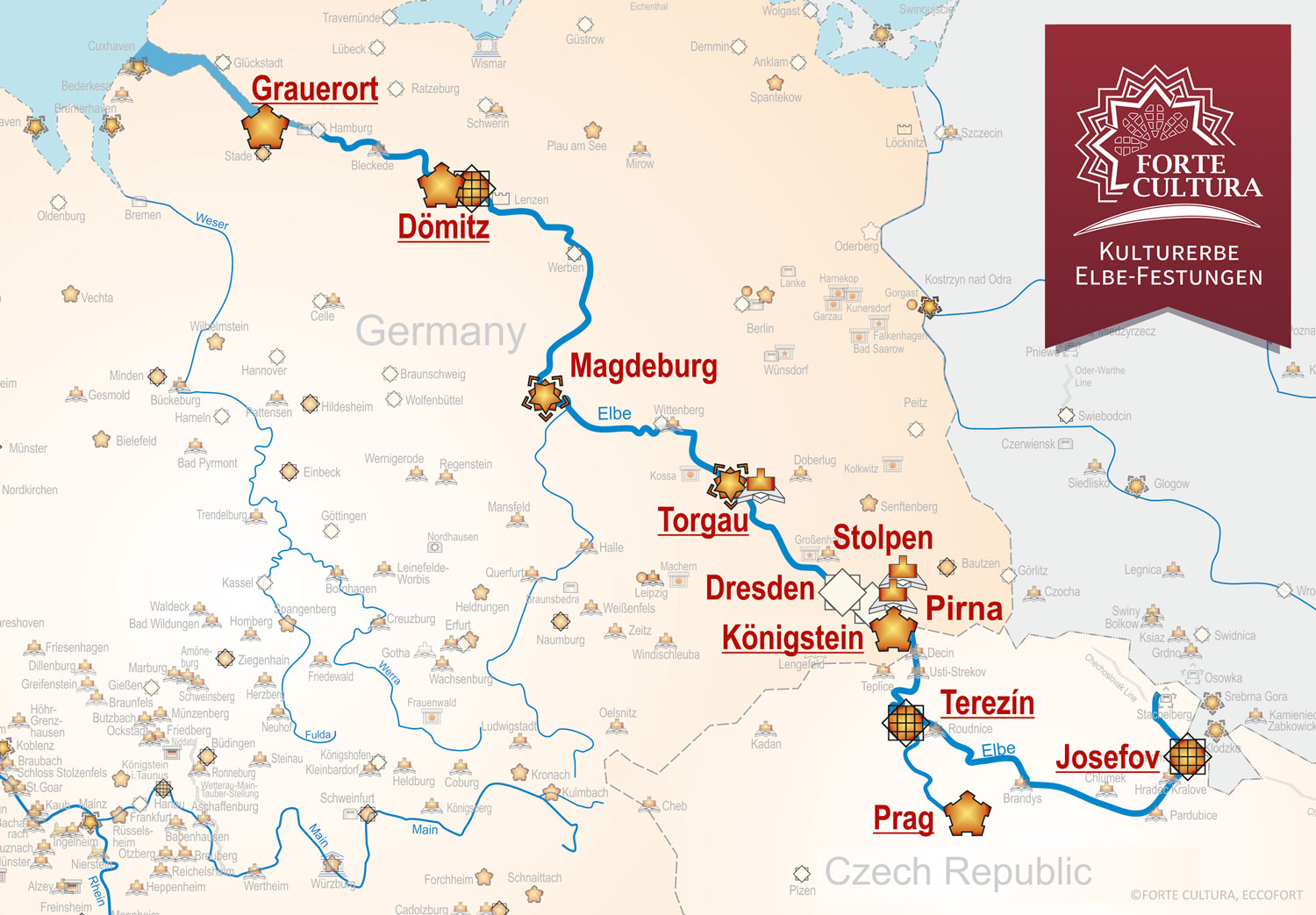
The Vyšehrad Fortress Prague in the FORTE CULTURA cluster of the „Elbe Fortresses“ and as part of the „Imperial Fortresses of Bohemia“
Cultural ribbon
fortified monuments
on the Elbe river
From its source in the Czech Giant Mountains to its mouth in the North Sea near Cuxhaven, the Elbe river connects 1091 kilometres of magnificent cultural landscapes.
Conquer the FORTE CULTURA Elbe fortresses and discover the region from a new perspective.
Imperial fortresses of Bohemia (CZ)
The imperial fortresses in Bohemia (CZ) are large fortified towns, some of which were built by the Habsburg emperors in the 17th and 18th centuries. Discover the largest fortresses in Europe from the heyday of modern fortress construction.

 Deutsch
 English (UK)
 Français
 Italiano
 Polski
 Español
 Čeština
Schreibe einen Kommentar