
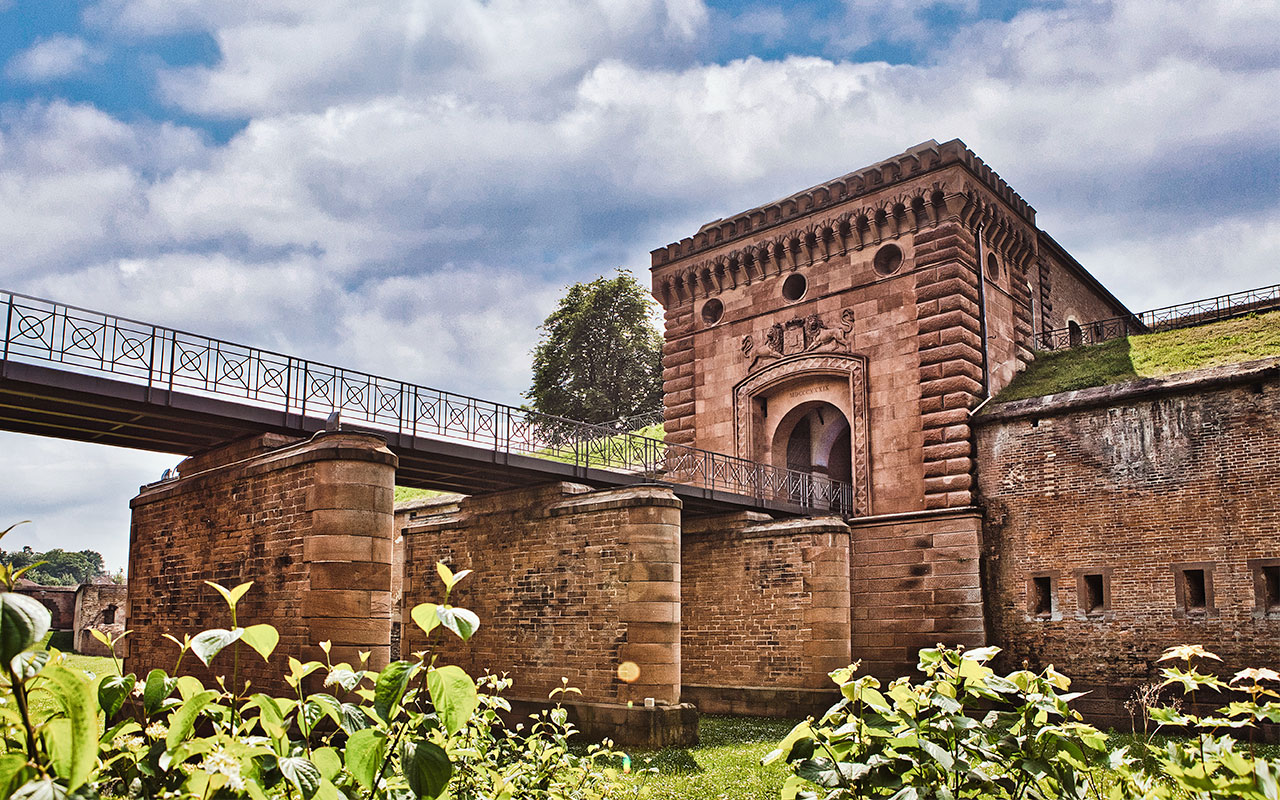
FORTE CULTURA Station: Fortress town of Germersheim (DE), Cultural Heritage Fortresses Upper Rhine
The fortress city on the Rhine
In the network of the Rhenish fortress line of the German Confederation
The imposing fortress town of Germersheim was built between 1834 and 1861 by order of the Bavarian King Ludwig I as a "bulwark against France". The largest Bavarian fortress outside Bavaria still shines in all its splendour today. Discover with FORTE CULTURA® the diverse and exciting tourist offer in the fortress town of Germersheim with scenic city tours, carriage rides, fortress wine tastings, bike and Segway tours and much more.
On the many guided tours and walks through the town and fortress of Germersheim, you can experience the impressive, well-preserved military buildings, the "Germersheim underworld", winding alleyways and romantic squares.

Learn the Fortified town of Germersheim on the Upper Rhine know:

Germersheim was a fortified town, consisting of modern fortifications that surrounded the city in an irregular geometry.
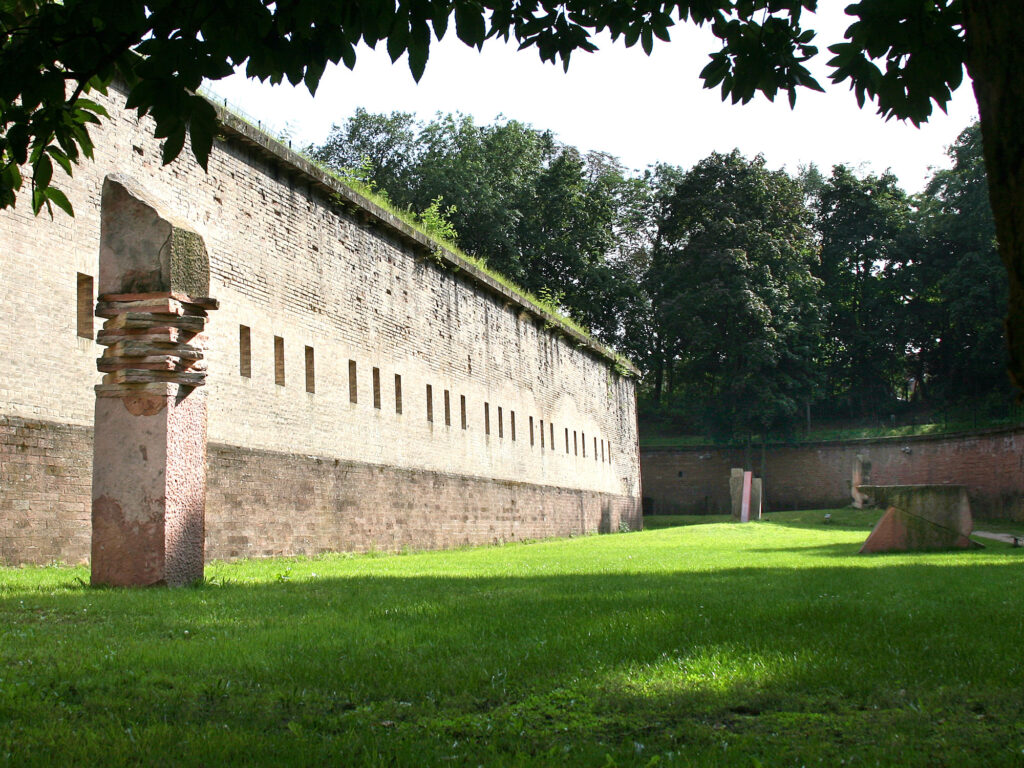
Front Beckers
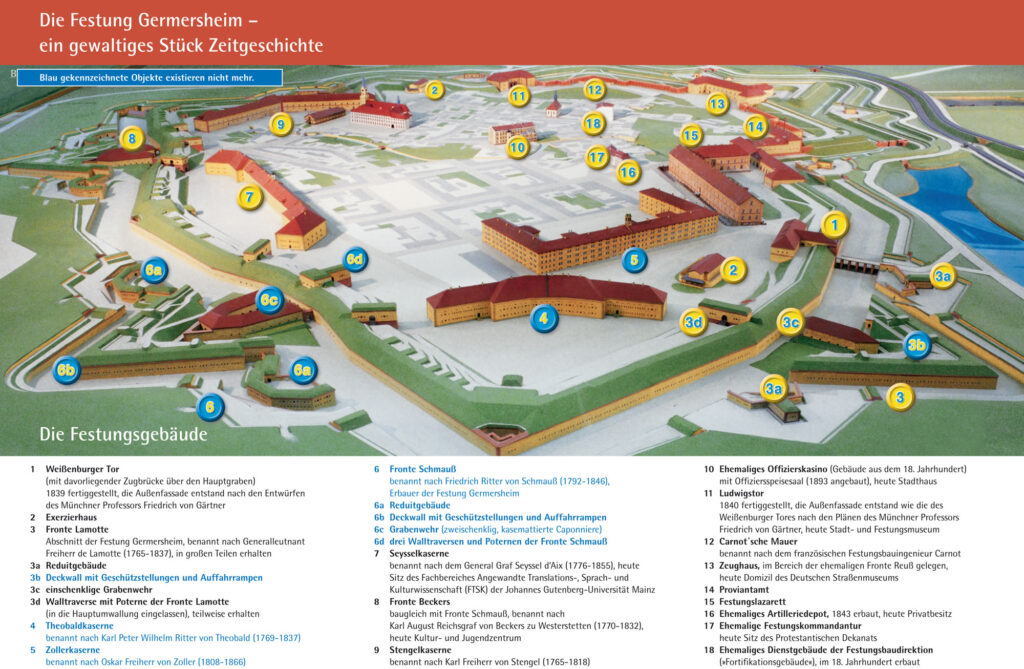
Alongside the Schmauß front, the Beckers front was the strongest front section of the fortification. This part of the fortress is still completely preserved over a length of 250 metres and impressively illustrates the fortification system in all its sections.
Particularly worth seeing and impressive are the two-legged moat defence, the main rampart with its traverses, the pillboxes, the underground infantry gallery and the mine system.
In the Fronte Beckers sculpture park, you can admire works by international artists between the old fortress walls and lush greenery. Concerts are regularly held in the beautiful ambience of the „Hufeisen“ cultural centre (referring to the shape of the fortress building).
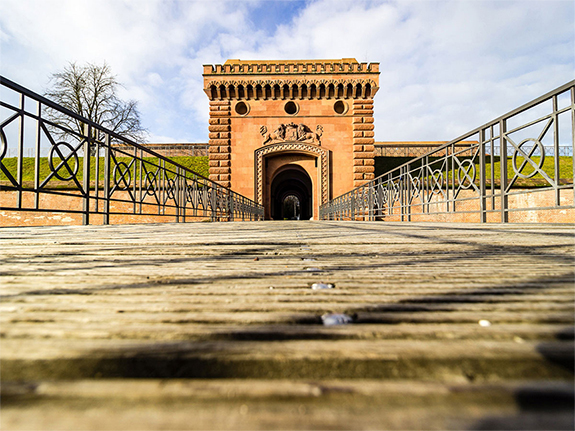
Weissenburg Gate
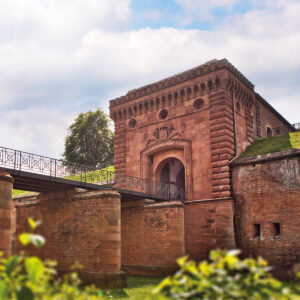
Designed according to the plans of the Munich professor von Gärtner, the „Weißenburger Tor“ city gate is one of the most beautiful and worth seeing buildings in the fortress complex. The city's landmark was built in 1839, has survived largely unscathed and has been converted into a modern and prestigious tourist, cultural and visitor centre.
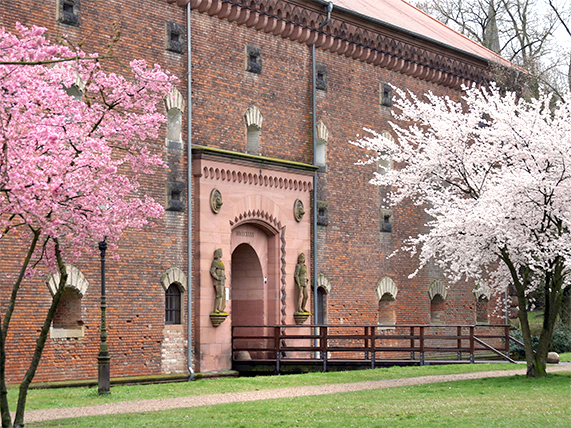
Ludwigstor
The Ludwigstor is the northern city gate of Germersheim Fortress and was completed in 1840. To the left and right of the passageway to the town are life-size statues which, according to tradition, depict King Ludwig I, under whose reign the fortress was built, on the left and Colonel Schmauß, the architect of the fortress, on the right.
In the historic gatehouse, the Germersheim Town and Fortress Museum invites you to marvel at interesting information and exciting exhibits. The large model of the fortress, which shows the „neo-Prussian fortification system“ of Germersheim, is also impressive.
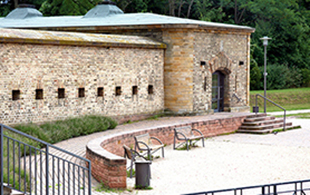
Front Lamotte
What remains of the Fronte Lamotte today are the single-barrelled moat weir and part of the main rampart, as well as two armoury reductions and the Weissenburg Gate. Taken together, the area forms the „Fronte Lamotte“ city park - a worthy backdrop for a variety of cultural events.
An attractive artists' studio has been created in an area of the former infantry gallery of the main rampart that was destroyed as a result of the demolition work, with partial reconstruction of the underground facilities. An absolute must for art and culture lovers: the Professor Deutsch Sculpture Museum.
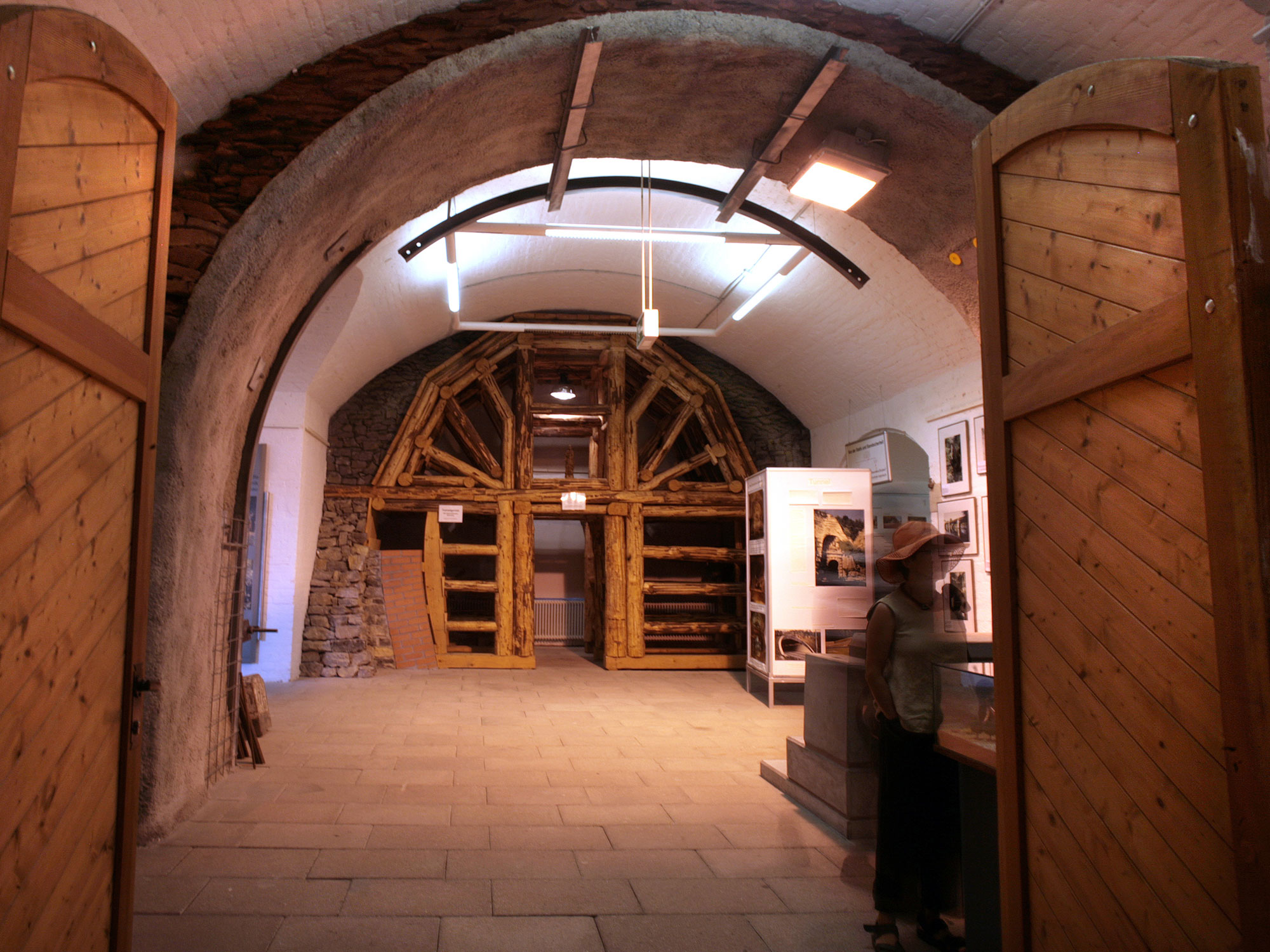
Armoury
The monumental building with a front length of 73 metres was the armoury of Germersheim Fortress. Weapons and equipment were stored here. A single-legged moat defence still stands in front of the building today. It was flanked by a Carnot wall facing the Rhine.
The impressive fortress building houses the German Road Museum, where you can learn about the history of road construction. Particularly exciting, and not just for railway enthusiasts, is the large model railway layout with currently around 700 metres of track in H0 format, which also includes the armoury in miniature format.
The spacious premises also house the exhibition rooms of an active art association.
Tourism office of the town of Germersheim
On the guided tours and walks through the town and fortress of Germersheim, you can experience the impressive, well-preserved military buildings, the „Germersheim underworld“, winding alleyways and romantic squares. In addition to personal advice and a wide range of information material, all kinds of information on tourism, leisure activities, art and culture is also available and accessible for visitors, day tourists, short breaks and business travellers. Germersheim has 6 tour guides with FORTE CULTURA certification.
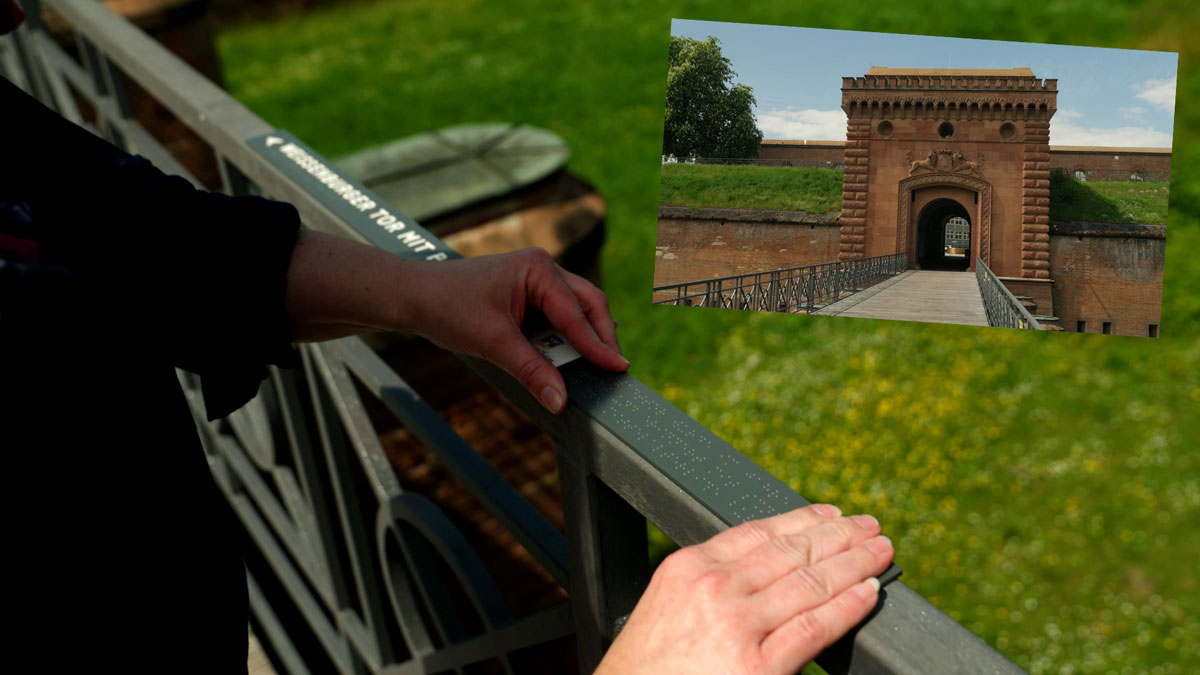
Perspective: Recognising Germersheim Fortress
The town of Germersheim is keen to make a contribution to reducing existing barriers. As part of a project funded by Aktion Mensch as part of the „#1 Barrier less“ programme, in 2022, together with FORTE CULTURA, a Fortress tour for blind and visually impaired people has been set up. The circular route leads through the most striking part of the fortified town of Germersheim and is equipped with tactile signs in Braille. In addition, a QR code enables explanatory audio files to be played for each location. Further information can be obtained from the tourist office in the Weißenburger Tor.

Passenger shipping Karlsruhe
As soon as the lines are cast off, you will experience a little harbour atmosphere on our passenger ship before heading out onto the river through the imposing barrier gate. Whether you prefer to sit sheltered behind glass and be catered for or enjoy a stiff breeze on the upper deck, you will experience unforgettable moments as you pass through the floodplain landscape.

CitySeg
Discover Germersheim with us. The old fortress town with lots of charm and history is located directly on the Rhine, nestled in impressive, unspoilt nature. A varied SEGWAY tour that you are sure to enjoy!
History of the fortified town of Germersheim
With the declaration of possession on 30 April 1816 by the Bavarian King Maximilian I Joseph, the Palatinate henceforth belonged to Bavaria. However, with the recovery of the left bank of the Rhine, it was also decided that the Rhine should once again be developed into a strong border defence in the event of renewed military conflict with France. The German Confederation therefore decided as early as 1815/16 to provide the town of Germersheim and the Rhine crossing with strong fortifications. In this case, the Kingdom of Bavaria remained in charge of the implementation, which realised the construction project with funding from the German Confederation, but ultimately built a Bavarian state fortress.
The fortress had the task of securing the river crossing and providing a firm base to cover the border against France. The crossing over the Rhine at this point was also the shortest connection between the Palatinate fortress of Landau and the right bank of the Rhine.
After King Ludwig I commissioned Engineer-Major Friedrich Schmauß to draw up the fortress plans in December 1832, the ground-breaking ceremony for the construction of the fortress took place on 30 June 1834. The foundation stone was then ceremoniously laid on 18 October 1834 at the head of the Beckers front line, exactly at the obtuse angle where it meets the Schmauss front line in front of the centre of the Seyssel barracks, in commemoration of the Battle of Leipzig.
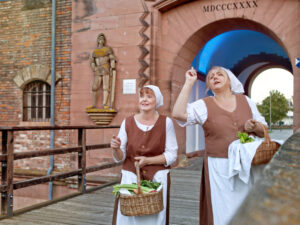
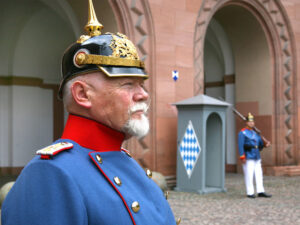
If you want to travel back in time, you can explore the massive walls of the historic fortress on one of the popular fortress tours or a staged tour with historical costumes.
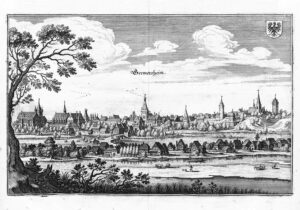
Architecture of the fortified town of Germersheim
The basic principle of the fortification was the polygonal caponier system in the Nine-Dutch style, or, as was common for fortresses of the German Confederation at the time, the so-called „New Prussian fortification style“. A system characterised above all by the caponiers or trench defences and casemated defensive buildings.
In the polygonal system, the ground plan is a polygon with straight or slightly broken fronts. Here in Germersheim there are 6 front sections, Beckers, Schmauß, Lamotte, Diez, Reuß and Carl, which surround the town for 3,200 metres as the main rampart or town rampart in the „nine Dutch style“. The infantry galleries of the main rampart began at the Diez front, passed through the Lamotte, Schmauß, Beckers and part of the Carl fronts, and had a total length of around 1,800 metres. This section formed a dry trench system with a trench width of up to 32 metres. From the infantry gallery, close defence could be taken over when the enemy was in the trench. However, it was also possible to move troops underground without exposing them to direct fire. The other 1,400 metres of the rampart had a wet trench system and therefore no galleries. This was fed by the backwater of the Queich at the Diez front - a sluice leading to the Rhine - and the tributary of the „Altbach“ - a branch of the Queich - at the Carl front.
In the centre of each frontage, a building was built into the trench from the rampart, the caponier or trench defence. They are equipped with embrasures so that the length of the trenches could be taken under fire with guns or rifles. The sections to the west and south-west were particularly strong, as an attack from this side was to be expected. The caponiers of these Schmauss and Becker sections were therefore designed with two legs, like a horseshoe. This meant that a larger number of guns, six on each side, could be deployed. The other fronts, which were additionally secured by the natural terrain, such as the Rhine, oxbow lakes and morass, are single-legged. The ditch defence is separated from the rampart and, as it is located deeper in the ditch, can be over-shot from the main rampart. These buildings were secured by a revetment, also in the „nine-Dutch style“. As this was located in front of the ditch defence, it was lower than the main rampart so that it would have been possible to take over the long-distance defence from the main rampart via the revetment. This is followed by another 20 metre wide ditch.
From the outer trench wall of the important fronts, Schmauß, Beckers, parts of Carl and Lamotte, where a connecting gallery was often constructed in the trench wall, a defence mine system emanated, the tunnels of which led underground out into the „glacis“. The main tunnels were 6 to 7 metres below the natural ground level and 10 metres below the edge of the glacis. They were lined with bricks and had a height of 1.87 metres and a width of 1.14 metres up to the vaulted crown. Smaller side tunnels, measuring 1.23 metres high and 0.60 metres wide, branched off from the main tunnels. In the event of war, black powder barrels would have been placed in the mine system to blow them up if the enemy were above them and thus hinder the enemy's advance.
The mine system alone was built from 1855 to 1861, i.e. 6 years, resulting in a total construction time of 27 years for Germersheim Fortress.
Military buildings are also part of the „New Prussian style“ inside the city. The barracks complexes are not purely troop accommodation, but so-called defensive buildings. They are usually aligned parallel to the rampart in order to provide a last line of defence in case the enemy got over the rampart.
The actual entrances to the fortress and therefore also to the town are located to the north of the arterial road towards Speyer and to the east towards the Rhine. They are secured by two fortress gates, the Ludwig Gate and the Weissenburg Gate.
The fortifications are completed by ten outworks and outlying fortresses, which were built around the main rampart in the rayon area and also extended to the parts of Germersheim on the right bank of the Rhine. These included the bridgehead at Philippsburg, which, together with the town fortifications, protected the two Rhine bridges. The fortifications of this belt fortification were laid out at intervals of 600 - 1,700 metres around the town.
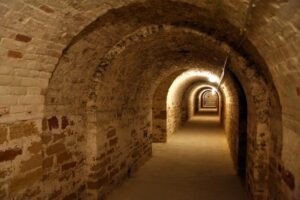
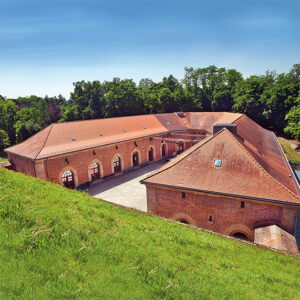
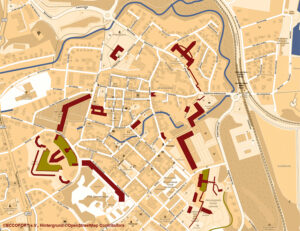
Fortress hiking trail around Germersheim
Pfälzerwald-Verein Germersheim: Trails through the fortress and nature
The Pfälzerwald-Verein Germersheim offers interesting and varied circular routes and tours through the town and the surrounding countryside for anyone who enjoys walking. As the terrain in and around Germersheim is flat, these tours, depending on their length and duration, are particularly suitable for families with children, but also for senior citizens. A special circular route offers interested visitors the opportunity to explore the interaction of former military and civilian functional buildings - as we have them in various places in the town and our fortress - and particularly beautiful spots, paths and places in the open countryside. There are plenty of places to sit and relax, rest, linger or have a chat in the clubhouse at Fronte Beckers.
Tree nature trail - Trees worth seeing in Germersheim
The Germersheim tree nature trail runs through large parts of the former glacis area of the fortifications built in the 19th century. Rare tree species, including exotic species, have been preserved in this area from the time when the glacis was planted. The vegetation in the cemetery is also worthy of note. The circular route of the tree nature trail begins and ends on the inside of the Ludwigtor. More hiking trails
PWV Sondernheim: Between the high banks and floodplains of the Rhine
The local branch of the Palatinate Forest Association in Sondernheim offers hikers and walkers beautiful footpaths and hiking trails between the high banks and floodplains of the Rhine. Take a break for a little refreshment in the beautiful clubhouse, directly on the Rhine dyke. The well-signposted hiking trail with the characteristic name „Rheinaue und Hochgestade“ (Rhine floodplain and high bank) shows the situation along the Rhine in the Upper Rhine Plain in its original form in a very vivid way. Explore and experience Germersheim and its marvellous, natural surroundings. It is great fun in the fresh Palatinate air and there is still a lot to discover here.
Boat trips in the Old Rhine and the Rhine floodplains
Treat yourself to a pure nature experience in Germersheim - explore the local flora and fauna from the water
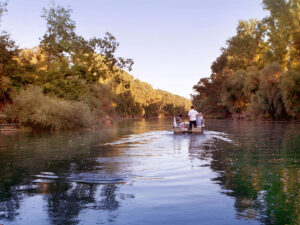
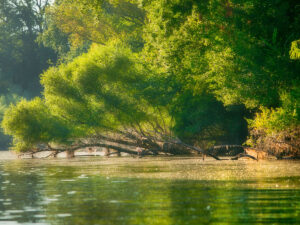
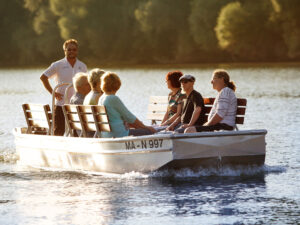
Discover the habitat of the local flora and fauna on a fascinating boat trip through the Old Rhine. Let expert boat guides lead you through the Rhine floodplains and experience a nature reserve of a very special kind. The floodplain landscape, which is characterised by regular flooding, is home to unique flora and fauna. The impressions experienced from the water provide information about the diversity of animals and plants in this protected amphibious landscape. Depending on the season, temperature or water level, the habitat, most of which is protected, offers space for new and fascinating experiences all year round.
Watch the mating rituals of the mallards while grey, silver or purple herons forage on the banks. In addition to cormorants, grey herons and ducks, you may be lucky enough to see the rare kingfisher. Cave-nesting birds raise their young in the silver willow and poplar trees, while the mating calls of various frog species can be heard from the ditches in the background. The wetlands are a veritable El Dorado for countless dragonfly species, which hunt for insects above the water surface in midsummer and can be easily observed from the boat. With a bit of luck, you might spot schooling fish spawning or swimming nutria. From the end of August, when many migratory birds have already left for the south, the first winter visitors return in the form of the great white egret and tufted duck. The trips take place from March to October. As the boat trips take place in a nature reserve, numbers are limited. Early booking is therefore recommended. Up to 12 seats are available per boat. The trip through the Rhine floodplains takes approx. 2 hours. To the offers
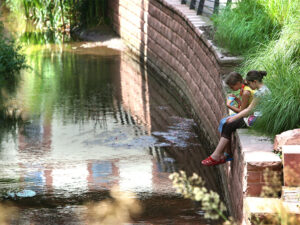
Event highlights in the fortress town of Germersheim
- May-September: Culture Summer - A varied cultural programme with top-class events at Germersheim Fortress
- Always in odd-numbered years: GERMERSHEIMER FESTUNGSFEST - The fortress town opens its gates and provides deep insights into the eventful history of the town
- Always in even years: GERMERSHEIMER GERMARES - Medieval market in the fortress
- Beginning of November: GERMERSHEIMER KULTUR- und MUSEUMSNACHT - experience culture and museums in the fortress town
Actionbound fortress town of Germersheim

Germersheim fortress rally for the whole family
We hope you enjoy exploring the fortress with our rally. Can you manage to answer all the questions? We'll keep our fingers crossed for you!
FORTE CULTURA guided tours in Germersheim
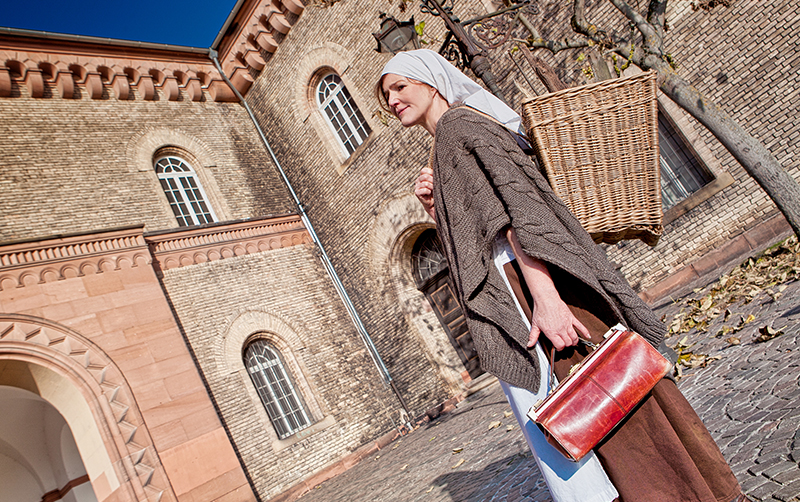
Germersheim city walk with midwife Josefine
Guided tour of Germersheim town and fortress
FORTE CULTURA travel recommendations with the fortified town of Germersheim
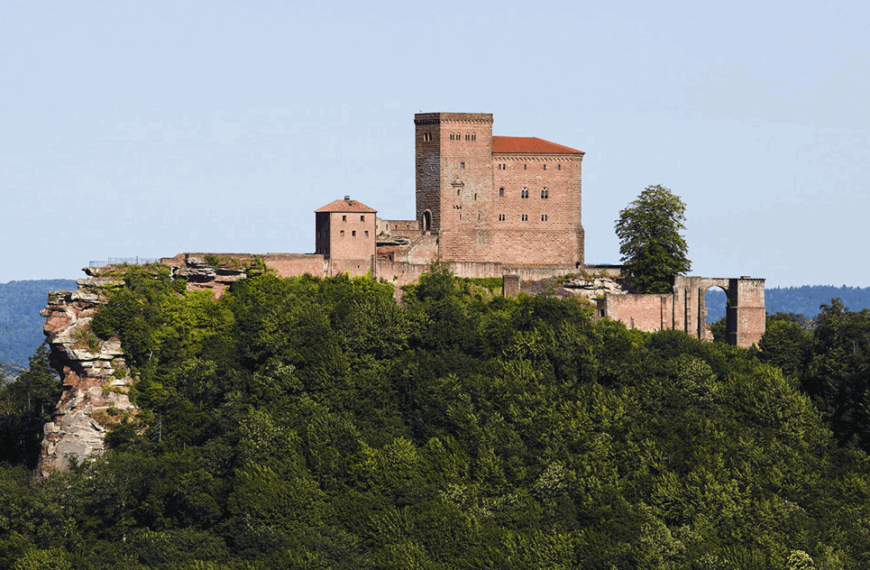
Fortified towns, fortified castles and fortresses in the natural paradise of the Palatinate Forest
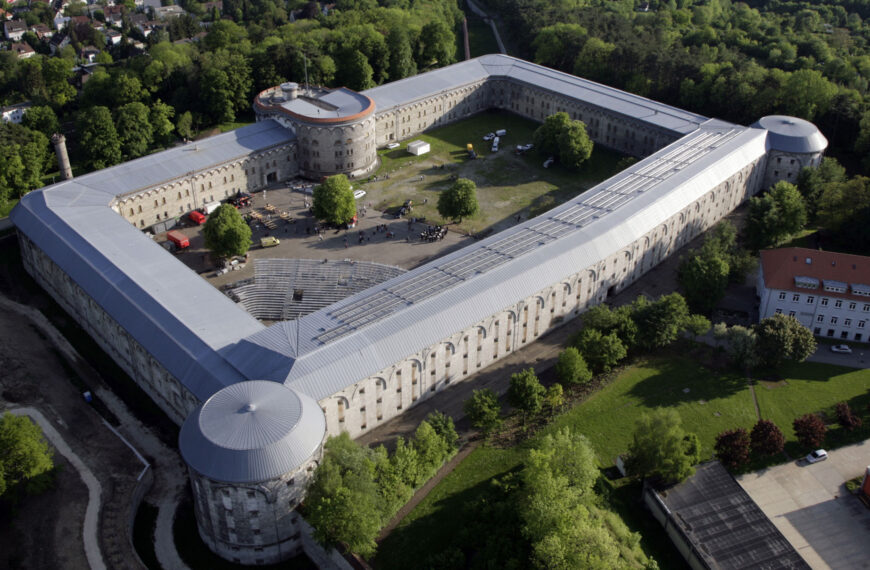
Fortresses of the German Confederation
Contact us
Contact us:
City of Germersheim: Weissenburger Tor tourism, culture and visitor centre
Paradeplatz 10
76726 Germersheim
Tel: +49 (0) 7274 / 960-301
e-mail
www.germersheim.eu
Tourism partner of the fortress town of Germersheim



Cultural heritage
fortified monuments
of the Upper Rhine region
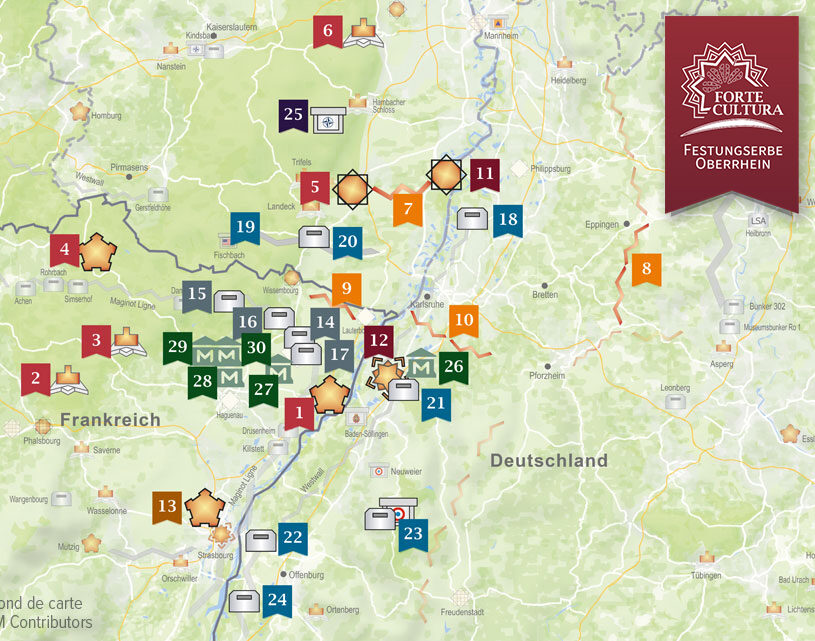
The Upper Rhine region is one of the most fought-over regions in Europe. Fortified monuments from all eras bear witness to this exciting cultural history. Today they are monuments full of life and culture.
Discover the history of fortress construction over the last 350 years in the 30 FORTE CULTURA fortresses and museums on the Upper Rhine.
Fortress INCLUSIVE
As a European cultural route, FORTE CULTURA helps to preserve the important cultural heritage of fortified monuments and make it accessible to everyone.
FORTE CULTURA inclusion projects
Together with the Aktion Mensch lottery, FORTE CULTURA regularly initiates projects to make the fortress landscape in Germany more inclusive and barrier-free, e.g. in the Aktion Mensch programme "#1 Barrier Less". We share information from our projects with our partner fortresses across Europe at international conferences, thereby raising awareness of inclusion in fortress tourism and supporting new projects.
Please contact our network office if you would like to support our initiatives.
Experience programmes for people with disabilities
FORTE CULTURA has created the following barrier-free experiences in fortresses:
- Germersheim Fortress: Tour for blind and visually impaired people with audio files and information in Braille,
- Feste Kaiser Franz Koblenz: Audio circular route in easy language,
- Fort Gorgast: German-Polish signposting and circular route in easy language.
Wenn du dies siehst, nachdem deine Seite vollständig geladen wurde, fehlen leafletJS-Dateien.
 Deutsch
  English (UK)
  Français
  Italiano
  Polski
  Español
Schreibe einen Kommentar