

FORTE CULTURA Station: Fortress Franzensfeste (IT) - Photo ©D.Röder
Franzensfeste - a masterpiece of Austrian fortress architecture
From a stronghold on the Brenner route to an open space for history, art and social interaction
Like a stone barrier, the Franzensfeste stretches across one of the most important north-south routes in the Alps. Built between 1833 and 1838, it was intended to secure the Brenner route and thus a strategically important access route to the Habsburg Monarchy. Covering an area of around 65,000 square metres, it is the largest historic building in South Tyrol.
The extensive fortress complex is now divided into the Lower, Middle and Upper Fortresses to aid navigation. Casemates, courtyards, powder magazines, battlements, ramps and staircases form a complex architectural system. Granite walls, massive brick vaults and long corridors lend the complex an atmosphere that is both fortified and almost sacred. An underground staircase with 452 steps connects the Lower Fortress with the Upper Fortress, situated some 90 metres higher up.
Although the Franzensfeste was designed as a virtually impregnable defensive barrier, it never actually became a theatre of war. Soon after its completion, it lost its military significance and, for many decades, served primarily as a warehouse, barracks and restricted military area.
Today, the Franzensfeste is a South Tyrolean provincial museum and a vibrant cultural venue. Exhibitions on the history of the fortress and the 20th-century bunker complexes are complemented here by contemporary art, events and a wide range of educational programmes. In addition, the Franzensfeste houses the BBT Infopoint. Although this is situated within the fortress grounds, it is not part of the museum’s organisational structure. The fortress, once built to mark a boundary, has now become an open space for exchange and interaction.

Discover Franzensfeste at the Brenner Pass know:

The Franzensfeste is a Fortress system consisting of individual structures, defensive lines and gun emplacements.
Exhibitions at the Franzensfeste
The spacious rooms of the Franzensfeste house permanent historical exhibitions, temporary special exhibitions and contemporary art. The exhibitions explore various aspects of the site’s history and link these to overarching themes such as borders, mobility, war, technology, memory and social change.
In addition to its permanent exhibitions, Franzensfeste regularly hosts temporary special exhibitions. These focus on historical, social, artistic or regional themes and offer visitors the chance to view the fortress from different perspectives.
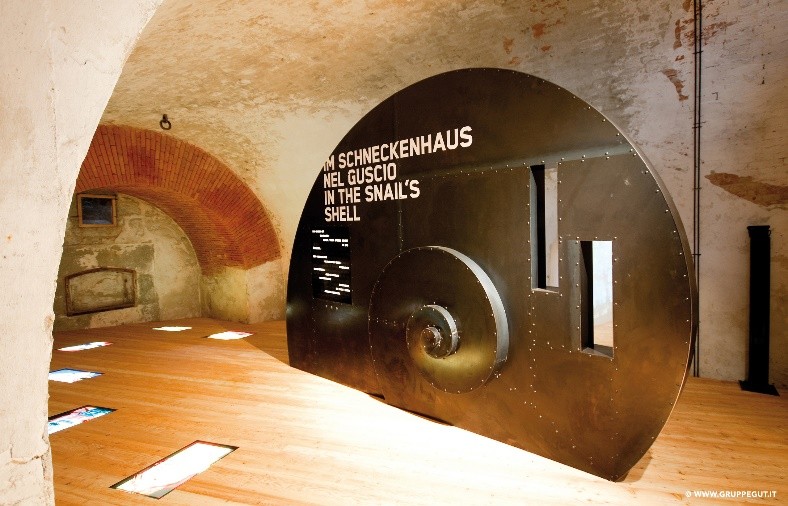
The Cathedral in the Desert
The permanent exhibition „The Cathedral in the Desert“ explores the history of the Franzensfeste, from its planning and construction to its current use as a museum and cultural venue.
Seven historic casemates explore the political and military background to the construction of the fortress, the massive building programme between 1833 and 1838, and the impact on the surrounding region.
Documents, historical illustrations, artefacts and multimedia elements provide insights into the architecture, working conditions on the building site and the daily lives of the soldiers. The fortress’s location on one of the Alps’ most important north-south routes also plays a central role. The exhibition also explores the history of the gold from the Italian National Bank that was stored at Franzensfeste during the Second World War.
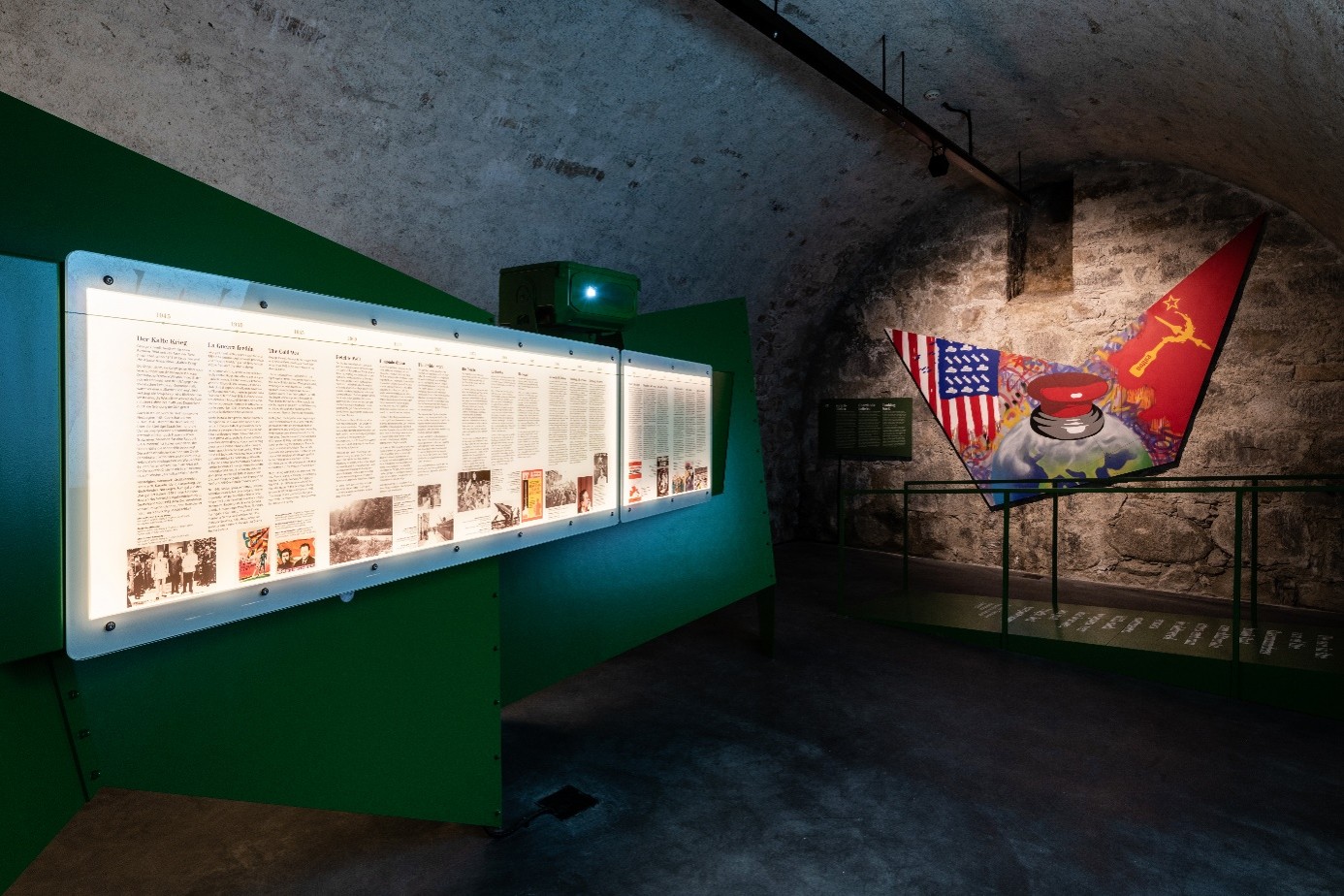
Hidden away. Bunkers in South Tyrol
The permanent exhibition „Under cover. Bunkers in South Tyrol“ focuses on the bunker complexes of the so-called Alpine Wall.
From the late 1930s onwards, Fascist Italy had an extensive defence system built along the Alpine arc. Several bunkers were also constructed in the vicinity of Franzensfeste, intended to secure transport routes, bridges and strategically important access points.
The exhibition also explores the subsequent use of the facilities during the Cold War. Several bunkers were reactivated, technically modernised and used for military purposes well into the second half of the 20th century.
The focus is not solely on architecture and military technology. The exhibition also explores the political context behind border security, armament, isolation and threats. In this way, the history of bunkers is linked to current issues concerning borders, security and peaceful coexistence.
The permanent exhibition „Eingebunkert“ can be complemented by a guided tour of the nearby Bunker No. 3.
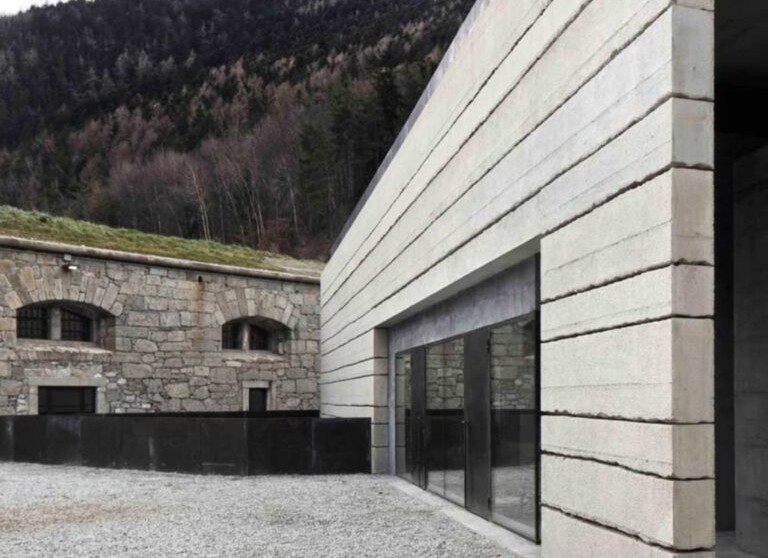
Brenner Base Tunnel (BBT) Information Point
The BBT Information Point is also located within the fortress grounds. It is housed by the Franzensfeste, but is not part of the South Tyrolean State Museum’s organisational structure.
Spanning around 200 square metres, the exhibition provides information on the construction of the Brenner Base Tunnel. Multimedia and interactive elements offer insights into geology, tunnel construction, construction logistics and the future rail link through the Alps.

Franzensfeste Fortress – South Tyrol Provincial Museum
Brennerstraße
39045 Franzensfeste
South Tyrol – Italy
Telephone: +39 0472 062950
e-mail
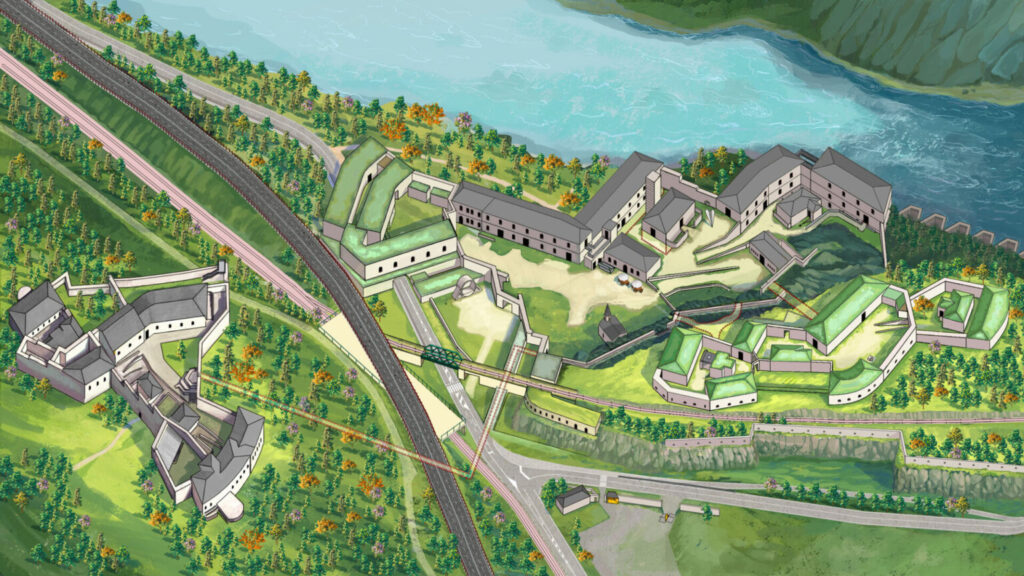
Franzensfeste – A monumental dam on the Brenner route
The Franzensfeste was built as a dam at a strategically crucial point along the Brenner route. Its location was chosen so that the transport routes through the narrow Eisack Valley could be controlled and, if necessary, blocked.
Architecturally, the complex follows the polygonal style of the New German School of Fortification. In contrast to regularly laid-out bastion-style fortresses, its layout is closely modelled on the natural terrain. The individual structures, defensive lines and gun emplacements were adapted to the valley floor, the rock formations and the variations in elevation.
The individual fortifications could be defended separately whilst at the same time providing mutual protection. Gates, moats, embrasures, casemates and covered passageways formed a complex defensive system.
Visitors to Franzensfeste will therefore discover not a single building, but a world of its own, comprising courtyards, passageways, staircases, walls and underground chambers.
Three sections of the fortress – three perspectives
Lower Fortress
The Lower Fortress is the largest part of the complex and the one that is most heavily used today. It is home to the main entrance, spacious courtyards, former barracks and administrative buildings, as well as numerous exhibition rooms.
Long, uniform building wings and a repetitive sequence of rooms still convey the functional logic of the former military complex today. At the same time, the historic rooms are used for exhibitions, events and contemporary art.
The climb to the Upper Fortress also begins at the Lower Fortress. The historic underground staircase, comprising 452 steps, covers a height difference of around 90 metres.
Middle Fortress
The Middle Fortress is situated on a natural rocky outcrop above the Lower Fortress. It is regarded as the most original part of the entire complex, as the Italian military carried out the least amount of structural work here compared with the other parts of the fortress.
As a result, numerous historical spatial structures and architectural details have been particularly well preserved. The Middle Fortress also offers a stunning view of the courtyards, roofs and wings of the Lower Fortress.
During the Second World War, large portions of Italy’s gold reserves were stored in a rock tunnel beneath this area.
Upper Fortress
The Upper Fortress lies some 90 metres above the Lower Fortress. It was an independent defensive area and was intended to protect the lower fortifications and the surrounding transport routes from above.
The ascent begins at the Lower Fortress and leads up via the underground staircase, which now has 452 steps. From the Upper Fortress, there is a sweeping view of the entire fortress complex, the village of Franzensfeste, the reservoir and the surrounding alpine landscape.
The Upper Fortress can only be visited as part of a guided tour.


A masterpiece of planning
The Franzensfeste is a significant example of polygonal fortification architecture in the New German School style. It marks the transition between older above-ground fortification systems and the new military and technical requirements of the 19th century.
Its architecture does not follow a regular geometric layout. Instead, the individual fortifications were precisely adapted to the valley floor, the existing rocks and the considerable differences in elevation across the terrain.
The geographically separate sectors were able to defend one another. Bomb-proof casemates, extensive lines of fire, gates secured in multiple ways, trenches, ramps and underground passages were designed to prevent an enemy advance through the Eisack Valley.
At the same time, provision had to be made for accommodation, stores, kitchens, workshops and administrative offices for a large crew. The monumental effect was achieved not through decorative splendour, but through function, repetition and the choice of materials. Granite, brick and timber define the spaces and lend the complex its unmistakable character.
Franzensfeste is situated in a location that has been shaped by movement for centuries. An Alpine pass, a road, a railway, cycle paths, a river, a reservoir and the Brenner Base Tunnel – currently under construction – all converge here within a small area.
The Alpine landscape is therefore not merely a backdrop, but an integral part of the fortress’s history. Rocks and narrow valleys shaped the military planning. The railway later cut through parts of the complex, whilst the reservoir altered the landscape and flooded the former hamlet of Unterau.
From the Upper Fortress, the view stretches out over the historic buildings, the village of Franzensfeste and the surrounding mountains. Cyclists can reach the site via the Wipptal or Pustertal cycle routes. Around the fortress, there are opportunities for walks and further excursions into the Eisack Valley, Wipptal and Puster Valley.
Thus, Franzensfeste does not merely recount military history. It also tells the story of how an Alpine landscape has been transformed over the centuries by politics, technology, transport and energy generation.


Events in the Franzensfeste
Exhibitions, concerts, conferences, workshops, family programmes and themed guided tours bring the extensive fortress grounds to life throughout the museum year.
The courtyards and historic rooms provide an exceptional setting for cultural and social events. In particular, the combination of monumental architecture, contemporary art and the Alpine landscape makes every type of event a special experience.
Wenn du dies siehst, nachdem deine Seite vollständig geladen wurde, fehlen leafletJS-Dateien.
 Deutsch
 English (UK)
 Français
 Italiano
 Polski
 Español
 Čeština
Schreibe einen Kommentar