
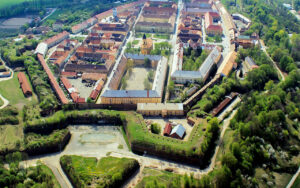
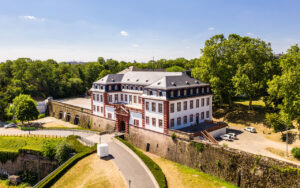
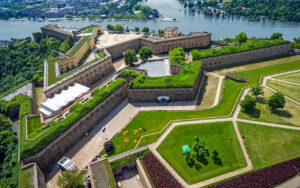
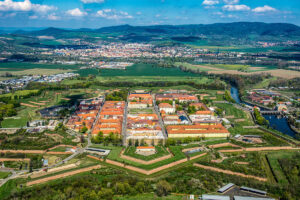
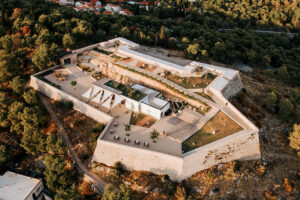
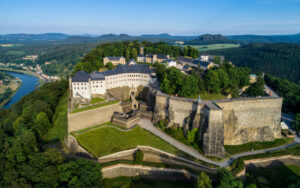
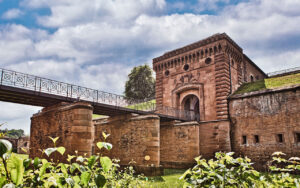
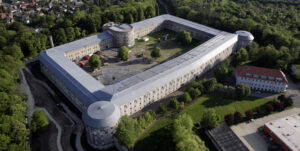
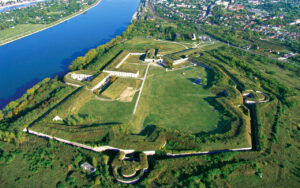
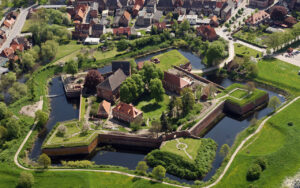
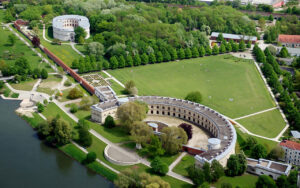
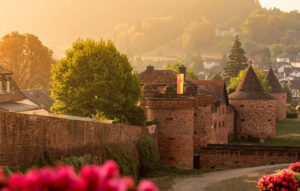
Fortress architecture is surprisingly diverse and varied, and fortress construction from the 15th to 19th centuries in particular produced fascinating and sometimes spectacular fortresses.
It is no exaggeration to speak of fortress construction ART since the architecture of these buildings strictly followed the in the past existing state of knowledge about the impact of armaments technology for the effective defence against any attacks. In doing so, former fortress engineers also utilized the wealth of nature for instance through the construction of moats and weirs located on rivers.
Renaissance bastions and fortified towns
The Renaissance bastioned fortress was one of Europe's great architectural responses to artillery warfare.
This new defence system, also known as „trace italienne“ utilised angular bastions, low walls, wide ditches and carefully calculated fields of fire. Its geometry allowed the defenders to cover every access route and reduced the vulnerability of the walls to cannon fire.
These principles not only changed individual fortresses, but entire cities. Fortified cities and ideal cities were planned according to military, urban planning and symbolic logic. Their walls, gates, bastions, streets and open spaces reflected a new relationship between defence, power, urban planning and landscape.
Throughout Europe, Renaissance and early modern fortifications show how military requirements influenced architecture and urban design. They also reveal the exchange of knowledge between architects, engineers and rulers.
Bastion fortifications were not only military structures, but also an expression of science, power and urban planning vision.
FORTE CULTURA draws attention to different types of fortifications in central Europe, their essential characteristics and distribution in order to provide an orientation for the interested tourist about the ‘Cultural Heritage of Fortified Monuments’.

Single Fortress
Single military defense building, usually consisting of military function buildings, barrier, ditch, bastions and cannon conditions.


Fortified ideal city
Of military architects and engineers of absolutist princes in the Renaissance planned military city with star shaped or chessboard-like geometry of the roads and the surrounding fortress buildings.

Citadel
Citadels are more independent, often geometrically with 4 or 5 bastions and a particularly well-developed part of a fortified city; the last refuge for defenders.
Fortified castle
Medieval castle reconstructed and supplemented with modern fortification elements after the emergence of firearms.
Fortified Palace
A residential castle equipped with fortification elements to protect against attackers or as architectonic decorative element.
Fortified sacred building
Cathedrals, basilicas, monasteries and also village churches which are equipped with typical fortification elements for the use of firearms.
learn more

Major fortress system
A major fortress system is a central fortress with a circular aligned chain of upstream fortifications such as single forts or batteries for the protection of cities and places for arms.

Lines of defence
Long stretched lines of defence for the protection of bigger regions as border installation, line fortress or territory fortress.
Wenn du dies siehst, nachdem deine Seite vollständig geladen wurde, fehlen leafletJS-Dateien.
 Deutsch
  English (UK)
  Français
  Italiano
  Polski
  Español