
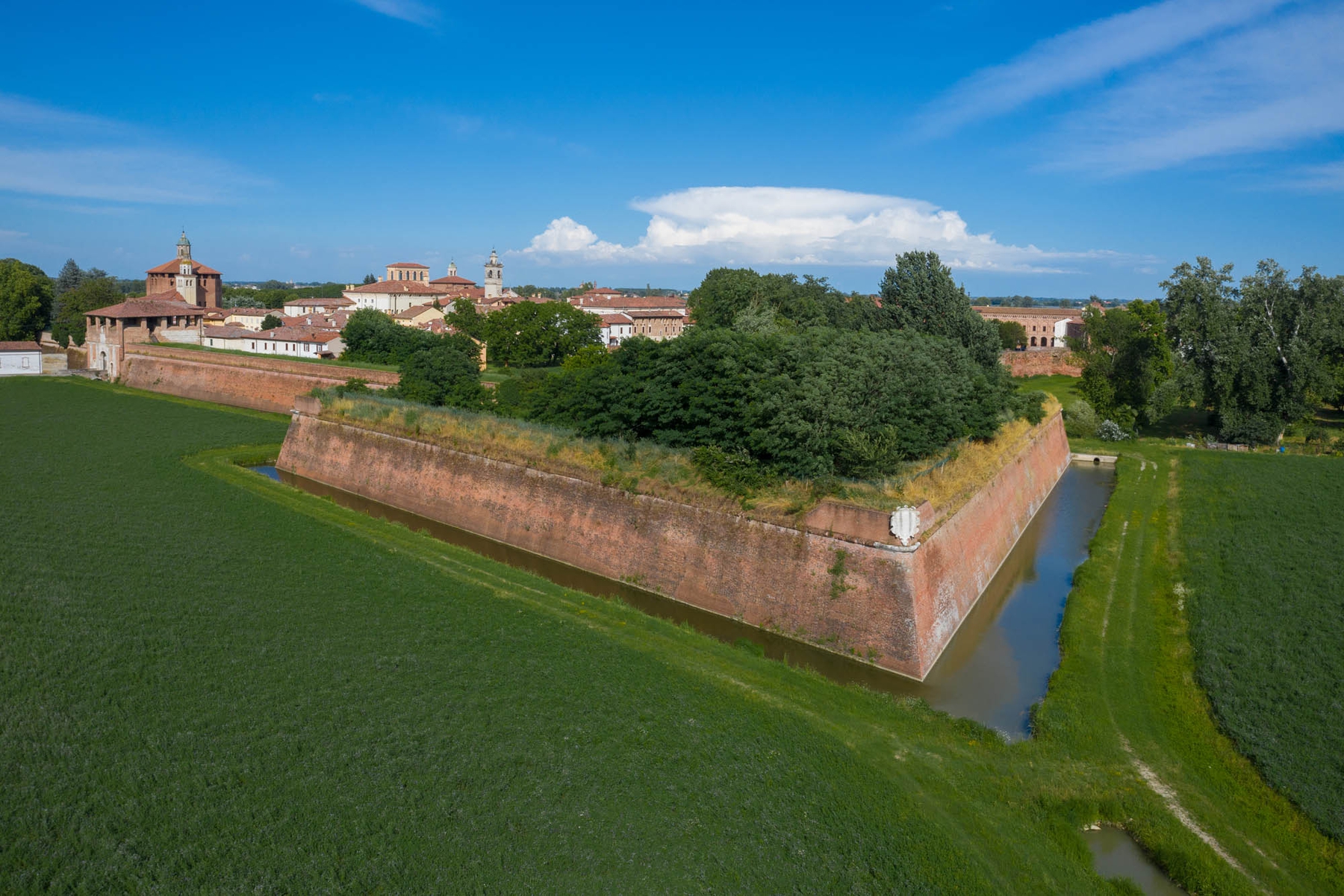
FORTE CULTURA Station: Ideal fortified town of Sabbioneta (IT)
The art of fortress construction in hitherto unknown perfection
UNESCO World Heritage Site and the oldest fortress city in Europe
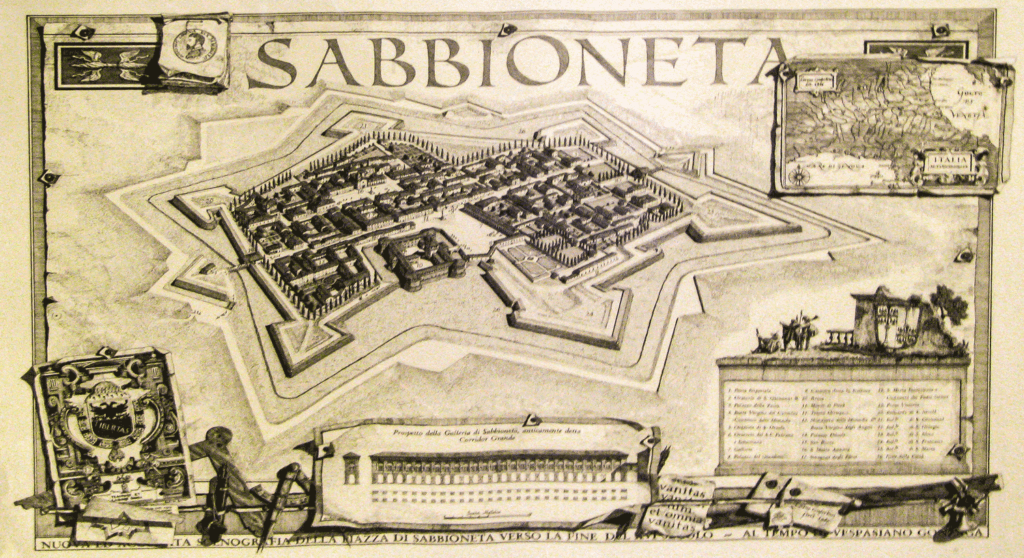
The fortified ideal city Sabbioneta was one of the first of its kind in Europe. It was also the first autonomous city founded during the Renaissance and one of the most ambitious urbanistic experiments of the European late Renaissance. In just 35 years, between 1556 and 1591, Sabbioneta transformed Vespasiano I Gonzaga Colonna A modest medieval settlement into a modern fortified ideal city, which was conceived as both a military stronghold and a humanist centre.
The city wall in the form of an irregular hexagon is completely preserved. Since 2008, the ensemble has been part of the UNESCO World Heritage Site. In addition to the impressive fortifications of the ideal city, Sabbioneta is also home to other wonderful historical buildings such as the Teatro Olimpico, the Palazzo Ducale and the Galleria degli antichi. Discover the fortified ideal city of Sabbioneta in Lombardy with its remarkable sights, exciting museums and events with FORTE CULTURA.

Get to know thehe fortified ideal city of Sabbioneta know:

Sabbioneta is a fortified ideal city, a military town created on the drawing board with a chessboard-like geometry.
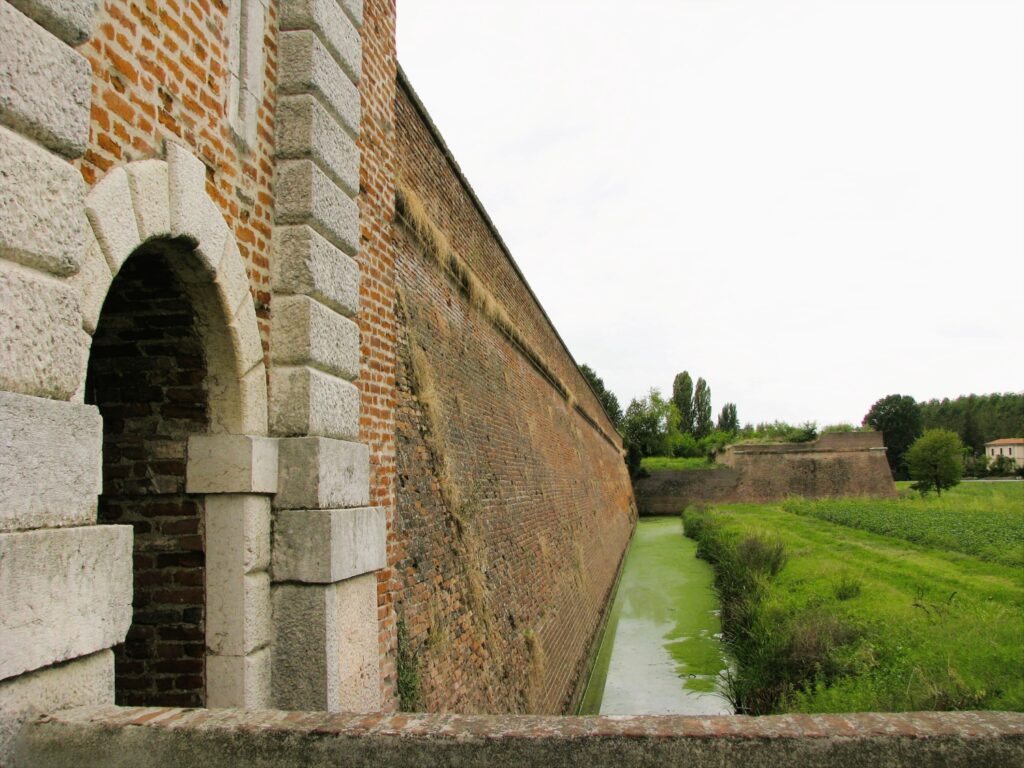
The city wall
Sabbioneta is enclosed by a massive wall, around six to seven metres high, which forms a irregular hexagon forms. This fortification was built between 1554 and 1591 under the direct supervision of Vespasiano Gonzaga and the engineer Giovan Pietro Bottaccio. Originally, the wall was surrounded by a water-filled moat up to 35 metres wide.
Today the Path on the walls (e.g. at Porta Vittoria) is accessible to visitors and offers a bird's eye view of the city structure.
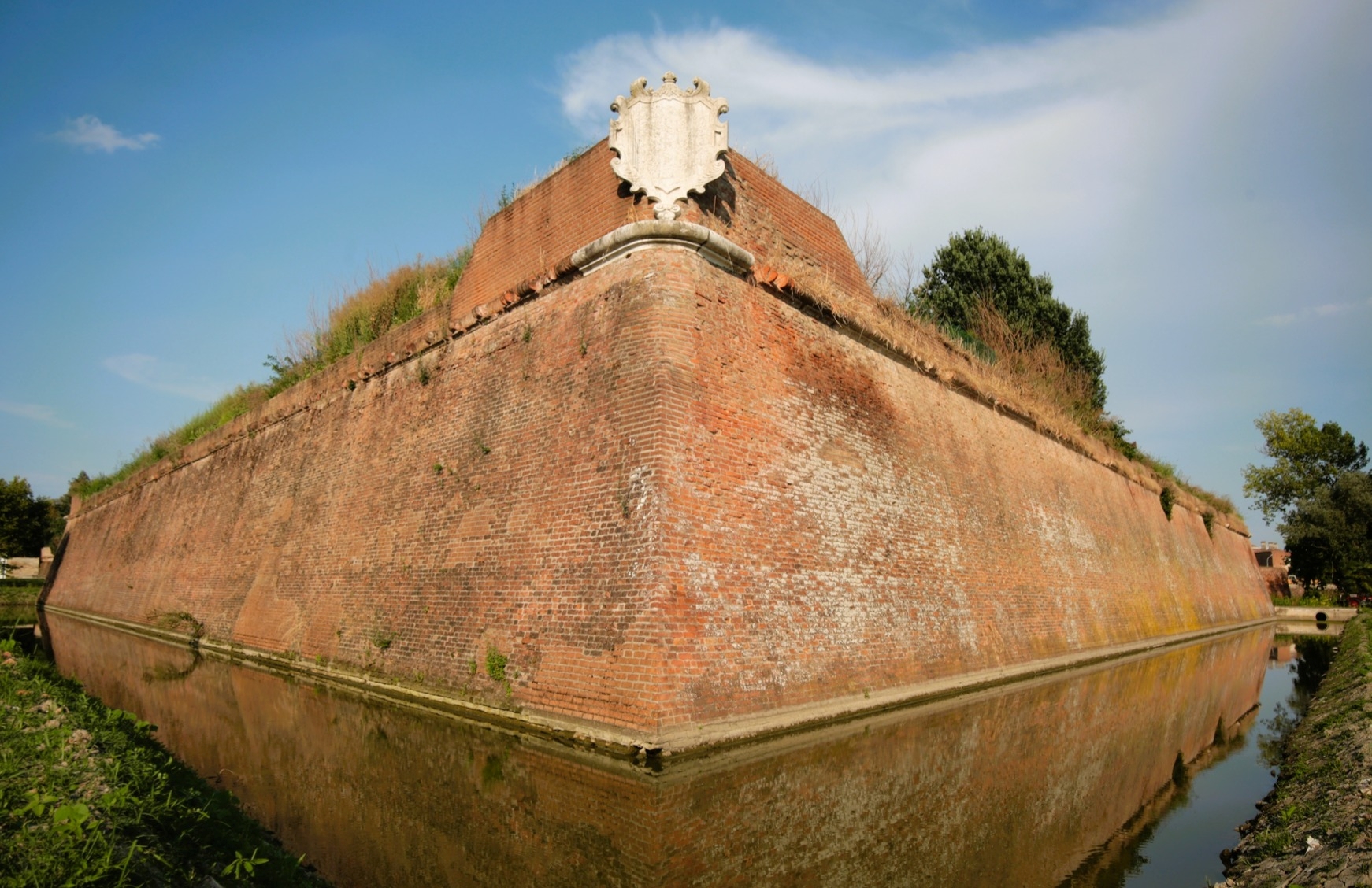
The six bastions
At the corners of the wall ring there are six protruding, pentagonal bastions, which were strategically placed so that they could cover each other. These are: San Nicola, San Giovanni, San Giorgio, Sant'Elmo and Santa Maria. They were built in the first construction phase up to 1568.
San Francesco: This bastion was only completed in the second phase (1578-1579) after the elevation to a duchy. Heavy mortars used to be stationed on these bastions to fire at besiegers, while the straight sections of wall (curtain walls) were protected by flanking fire from the bastions.
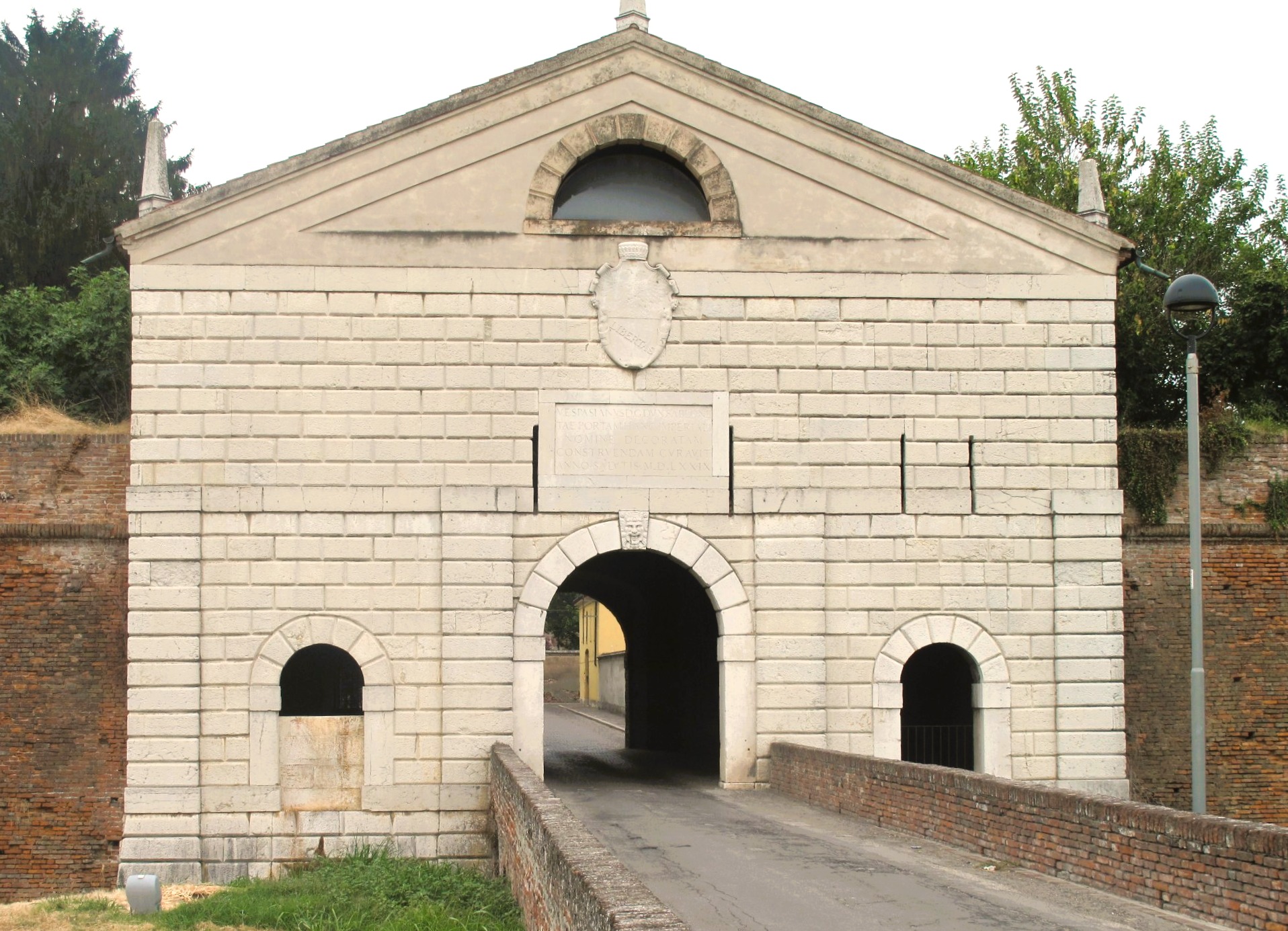
The monumental city gates
Two magnificent gates controlled the entrance and also served as military guard posts and stately triumphal arches:
- Porta Vittoria (1560-1562): The oldest city gate faces west. It has an upper loggia from which soldiers could monitor traffic. An inscription celebrates Vespasiano as the founder and victor.
- Porta Imperiale (1579): This gate facing east (towards Mantua) is completely clad in white marble. It documents Vespasiano's rank as duke and was originally equipped with two drawbridges.
Architecture of power and culture
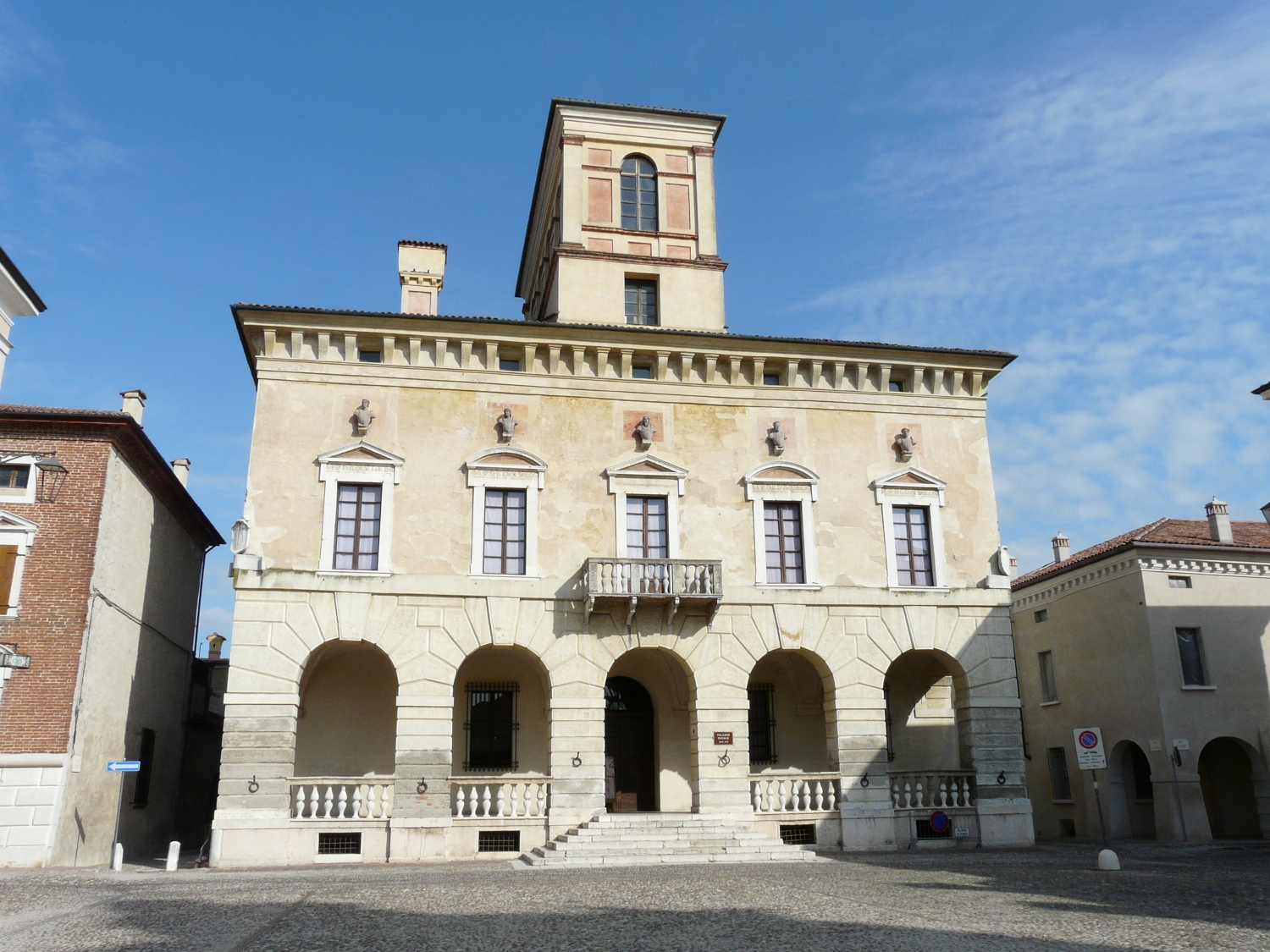
Vespasiano created a city of short distances, in which he was able to „Piano Nobile of the city“ a system of elevated corridors that connected palaces, theatres and churches without having to touch the ground.
- Palazzo Ducale: The official centre of power with magnificent halls and life-size equestrian statues of the ancestors.
- Palazzo Giardino & Galleria degli Antichi: A private sanctuary of leisure, combined with a 97 metre long gallery, which once housed Vespasiano's important collection of antiquities.
- Teatro all'Antica: Built by Vincenzo Scamozzi, It is considered to be the first independent, roofed theatre building of modern times.

UNESCO World Heritage Site and visitor information
Sabbioneta is now run as an „open-air museum“. An integrated ticket system allows access to all the important monuments.
- Highlight: The duke's mausoleum in the church Beata Vergine Incoronata, where he was buried with his most valuable honour, the Order of the Golden Fleece.
- Tickets: The „Biglietto Unico“ comprises all 7 main monuments.
- Accessibility: As there is no railway station, the journey is usually made by bus from Mantua or Parma or via the 47 km long Mantova-Sabbioneta cycle path.
Historical milestones
The history of the city is inextricably linked to the life of its founder, a condottiero and humanist intellectual.
- 1554-1560: Work begins on the massive city wall.
- 1560-1562: Completion of the Porta Vittoria, the oldest city gate.
- 1577: Elevation of Sabbioneta to a duchy by Emperor Rudolf II.
- 1579: Construction of the Porta Imperiale as a sign of the new ducal status.
- 1588-1590: Construction of the Teatro all'Antica, the cultural highlight of the city.
- 1591: Death of Vespasiano; the city falls into a „political slumber“ that preserves its Renaissance image.
A city from the drawing board: geometry and vision
Unlike cities that have grown organically, Sabbioneta is based on a strict geometric grid. The city planning follows a precise astronomical logic: the outline is inscribed in a square whose diagonals are precisely aligned with the cardinal points. A second ordering system is based on the position of the sun at the time of Vespasiano's birthday on 6 December. Even the measuring system was locally defined: The „Braccio di Sabbioneta“ (Sabbionetic cubit) is symbolically anchored in the statue of Minerva in Piazza Castello.
Microcosm Sabbioneta
The birthday of Vespasiano I Gonzaga Colonna on 6 December plays a fundamental role in Sabbioneta's astronomical and geometric logic, as it serves as the basis for one of the city's two central organisational systems.
• Astronomical alignment (solar azimuth): While the outer square of the city is orientated according to the cardinal points, the internal layout of the streets, squares and building blocks (insulae) follows the position of the sun (azimuth) on the day of Vespasio's birth.
• Alignment of the main axes: Today's Via Vespasiano Gonzaga, which crosses the entire city as the main axis, is precisely aligned with this „Dies Natalis“. The longitudinal axis of the Palazzo Ducale follows this mathematical specification.
• Symbolic staging of power: The architecture enabled the prince to ritually link his rule with the cosmos. When he stepped onto the balcony of the palace on his birthday at the exact hour of his birth (around half an hour after sunrise), the sun appeared exactly opposite him above the roof.
• „Natural law“ rule: This precise planning allowed Vespasiano to symbolically „walk with the sun“ through his ancestral chambers and study to the throne room. This effect was intended to convey the impression that his appearance and his exercise of power were as inevitable and natural as the rising of the sun itself.
Sabbioneta has thus been recognised as a Microcosm in which the built reality of the city corresponded directly with the individual biography of the ruler and the cosmic order.


Mantova-Sabbioneta cycle pathThe 47 kilometre long Mantova-Sabbioneta cycle path connects the two UNESCO cities and leads through the wide, flat fields of the so-called „Basso Mantovano“. (komoot)
Green belt around the city wall: Directly outside the historic fortifications is a protected area that is known as the Undevelopable green space must be preserved. This star-shaped area follows the design of the old defence works and invites you to take a walk in the greenery.
Idyllic landscape: The region around Sabbioneta is described as a „vast, flat green plain“ where visitors can enjoy the tranquil rural atmosphere and enjoy the sounds of nature, such as the „screeching of the jays“. The area is also known for its atmospheric „misty dawns“.
Proximity to the river Po: The city is only a few kilometres from the Po the largest river in Italy. The history of the land on which Sabbioneta stands is closely linked to water: It was originally marshland that was drained by Benedictine monks.
Oglio Sud Park: Just a few kilometres from Sabbioneta are the 16 municipalities that make up the Oglio Sud Park, a river park that extends over more than 12,700 hectares in the provinces of Cremona and Mantua. The park was created to protect the typical wetlands of the region and is home to many plant species (rushes, willows, alders, poplars, oaks) and animals, especially birds. The most famous protected areas are the Riserva Naturale Le Bine, not far from Calvatone and 23 kilometres from Sabbioneta, and the Riserva Naturale Torbiere di Marcaria, a nesting site for herons. Within the park there are countless cross-country routes on tarmac and unpaved side roads. In addition, the entire course of the river within the park runs along the Greenway dell'Oglio on its right bank, which is signposted with special information boards. https://www.ogliosud.it/


Events in the fortified model town of Sabbioneta
Contact us
Fondazione Sabbioneta Heritage
Palazzo del Cavalleggero,
Via Teatro 2, 46018 Sabbioneta MN
Italy
Wenn du dies siehst, nachdem deine Seite vollständig geladen wurde, fehlen leafletJS-Dateien.
 Deutsch
  English (UK)
  Français
  Italiano
  Polski
  Español
Schreibe einen Kommentar